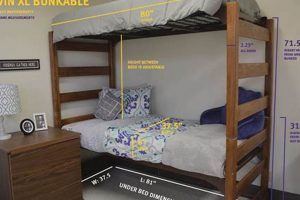
An RV queen mattress presents a compact sleeping solution tailored for recreational vehicles. It offers a compromise between space efficiency and sleeping comfort. Dimensions typically measure around 60 inches in width and 75 or 80 inches in length, although variations exist. For example, a standard residential queen mattress is typically longer than its RV counterpart.
Selecting the correct mattress dimensions is vital for optimal use of space within the limited confines of an RV. A well-fitting mattress enhances comfort during travel and ensures easy movement within the vehicle. Historically, mattress sizes were not standardized, leading to fitment issues in RVs, but increasing demand has led to more consistent measurements. This contributes significantly to the overall travel experience.
Understanding these dimensions is the first step. Subsequent sections will delve deeper into specific size variations, factors affecting size choice, and considerations for selecting the ideal mattress for individual RV needs, ensuring comfort and efficient utilization of available space.
Tips on RV Queen Mattress Dimensions
Selecting the right mattress dimension for an RV requires careful consideration. The following tips provide guidance for informed decision-making.
Tip 1: Measure the Available Space Accurately: Before considering mattress options, measure the RV sleeping platform precisely. Account for any obstructions or built-in structures that may affect mattress fit. Use a measuring tape to determine the length and width of the space.
Tip 2: Verify Manufacturer Specifications: Mattress manufacturers may list nominal sizes that differ slightly from actual dimensions. Confirm the exact measurements listed on the product specifications before purchasing.
Tip 3: Account for Bedding Thickness: Factor in the thickness of bedding, such as sheets, blankets, and mattress toppers. These additions can add to the overall dimensions, potentially causing fitment issues. Consider compressed bedding options for minimal space intrusion.
Tip 4: Consider Mattress Type: Different mattress types, such as memory foam, innerspring, or hybrid, may compress or expand differently. Research the behavior of each type to ensure compatibility with the RV’s sleeping space.
Tip 5: Prioritize Comfortable Thickness: Mattress thickness impacts sleeping comfort. Ensure the selected mattress provides adequate support while also fitting comfortably within the height constraints of the RV bedroom.
Tip 6: Check for Return Policies: Whenever possible, purchase mattresses from retailers that offer a reasonable return policy. This allows for testing the mattress within the RV and returning it if the dimensions prove unsuitable.
Tip 7: Consider Custom Options: If standard mattress sizes do not fit the RV’s space, explore custom-made options. Specialized mattress manufacturers can create mattresses with unique dimensions and shapes.
These tips emphasize the importance of precise measurement, specification verification, and bedding considerations. Adherence to these guidelines promotes informed selection and a comfortable sleeping environment.
The following sections delve further into specific mattress types and their suitability for the RV lifestyle, helping the reader select a mattress that balances comfort, space efficiency, and budget.
1. Width (Inches)

The width of an RV queen mattress is a primary determinant of its suitability for a given recreational vehicle. It directly affects the amount of sleeping space available and influences maneuverability within the RV’s sleeping quarters. Accurate measurement and understanding of width dimensions are essential.
- Standard Width Dimensions
RV queen mattresses typically adhere to a standard width of approximately 60 inches. However, slight variations may occur between manufacturers. Variations exceeding an inch or two can create issues with bed frame compatibility and usable floor space. Deviations also impact the fit of standard queen-size bedding.
- Impact on Occupancy
The width directly affects the number of occupants who can comfortably use the mattress. A width of 60 inches is generally suitable for two adults, but individual preferences for sleeping space may vary. Insufficient width can lead to discomfort and restricted movement during sleep. For instance, couples who prefer substantial personal space may find a standard width restrictive.
- Considerations for Slide-Outs
In RVs equipped with slide-out compartments, mattress width must be carefully considered in relation to the available space when the slide-out is retracted. An overly wide mattress can obstruct passage or prevent the slide-out from fully closing. This situation can render the RV immobile or lead to mechanical damage. Measurements should be taken when the slide-out is both extended and retracted.
- Influence on Bedding Options
Mattress width directly influences the availability of suitable bedding options. Standard queen-size sheets, blankets, and comforters are designed for a width of 60 inches. Deviations from this standard may require custom-made or altered bedding, increasing costs and limiting choices. Using oversized bedding can lead to excessive material hanging off the edges of the bed.
In summary, the width, typically 60 inches, determines the space for occupants and affects the ease of movement, compatibility with slide-outs, and range of available bedding. Therefore, width merits close attention when assessing mattress compatibility.
2. Length (Inches)

The length dimension of a recreational vehicle queen mattress is a critical factor that directly influences sleeping comfort and space efficiency. Its appropriate selection is vital for optimal functionality within the confined environment of an RV.
- Standard and Short RV Queen Lengths
While standard residential queen mattresses generally measure 80 inches in length, RV queen mattresses often come in shorter variations, typically 75 inches. This reduction in length is intended to maximize space within the RV. Selection between the 75-inch and 80-inch length should be predicated on the available bed platform dimensions and occupant height. A taller individual may find the 75-inch length restrictive.
- Impact on Sleeping Comfort
The length directly correlates to sleeping comfort, particularly for individuals of above-average height. Insufficient length can result in discomfort, as feet may hang off the edge of the mattress, or the sleeper may need to assume a curled position. Adequate length ensures full body support and promotes restful sleep. For example, an individual exceeding 6 feet in height may require the 80-inch version.
- Space Optimization Considerations
Selecting the appropriate length is also contingent upon the physical constraints of the RV bedroom area. The 75-inch version offers enhanced space optimization, allowing for greater maneuverability and potentially accommodating additional storage or seating. However, this benefit must be weighed against the potential compromise in sleeping comfort. A longer mattress necessitates a larger sleeping area, reducing available living space.
- Bed Frame and Bedding Compatibility
The length of the mattress must align with the dimensions of the RV bed frame. Incompatibility can lead to instability and uneven support. Furthermore, bedding must be appropriately sized. Standard queen-size sheets designed for 80-inch mattresses may not fit snugly on a 75-inch RV queen, requiring specialized or altered bedding. Careful attention should be paid to these considerations during the selection process.
In conclusion, length constitutes a pivotal attribute, dictating the sleeping comfort, space optimization, and compatibility with RV infrastructure. Choosing between 75-inch and 80-inch options requires meticulous assessment of individual needs and RV specifications. An informed choice directly contributes to a satisfactory travel experience.
3. Thickness (Inches)

The thickness of an RV queen mattress interacts significantly with its overall size and intended use within the confined spaces of recreational vehicles. Thickness influences comfort and support but also affects headroom and storage capacity. An inadequate understanding of this dimensional factor can result in discomfort or impede functionality within the RV.
Increased mattress thickness typically provides enhanced cushioning and support, leading to improved sleep quality. However, greater thickness reduces headroom and can make accessing upper storage compartments more difficult. Conversely, a thinner mattress saves space but may compromise comfort and support. For example, a 12-inch thick memory foam mattress offers substantial comfort but might prove too tall for an RV bunk, whereas a 6-inch innerspring mattress could be insufficient for heavier individuals. The selection of thickness necessitates a balanced consideration of comfort and spatial constraints. The thickness influences not just the sleeper’s direct experience but impacts the surrounding environment by influencing available headspace, clearance for slide-outs and how the unit fits into the overall space.
In conclusion, thickness, as a dimension of an RV queen mattress, is not a mere aesthetic attribute but a functional determinant of both comfort and space utilization. Addressing this element thoughtfully ensures the selection of a mattress that optimizes the RV’s interior environment and fulfills sleeping requirements without compromising functionality.
4. Corner Shape
The corner shape of a recreational vehicle queen mattress, although seemingly a minor detail, plays a significant role in optimizing space utilization and ensuring proper fit within the often-constrained dimensions of RV bedrooms. Variations in corner shape can impact the overall functionality and aesthetics of the sleeping area.
- Square Corners
Square corners represent the most common configuration for residential mattresses. However, in the context of RVs, square corners can present challenges. Their rigid right angles may not align seamlessly with the curvature of RV walls or built-in furniture, potentially leading to wasted space and awkward protrusions. A square cornered mattress placed against a curved wall can create a gap, rendering that space unusable. Therefore, careful measurement and consideration of existing RV structures are crucial when selecting a square-cornered mattress.
- Rounded Corners
Rounded corners offer a more adaptable solution for RVs. The softened edges allow for a more forgiving fit against curved walls and furniture. This shape mitigates the risk of sharp protrusions and maximizes usable space by conforming more closely to the RV’s interior contours. Mattresses with rounded corners are particularly advantageous in RVs with non-rectilinear layouts, as they reduce the likelihood of interference with other fixtures.
- Cut Corners (Angled)
Cut corners or angled corners represent a specialized design intended for RVs with unconventional bed platforms. This configuration involves removing a section of one or more corners, often at a 45-degree angle. This accommodation addresses space limitations imposed by wheel wells, cabinetry, or other structural elements. The effectiveness of cut corners hinges on precise matching with the specific architectural features of the RV. Incompatibility negates the benefits and can create instability.
- Custom Corners
In situations where standard corner shapes prove inadequate, custom-designed corners offer a tailored solution. These are typically manufactured to address unique architectural constraints within an RV, allowing for a seamless integration with existing structures. Custom corners demand precise measurements and may involve higher manufacturing costs, but they guarantee optimal space utilization and aesthetic harmony. For example, a custom corner might be required to fit around a built-in nightstand or a non-standard wall configuration.
The selection of an appropriate corner shape should be driven by a comprehensive understanding of the RV’s interior architecture. Whether square, rounded, cut, or custom, the corner shape influences space efficiency, fit, and the overall aesthetic coherence of the sleeping area. This element warrants careful consideration to ensure a comfortable and functional RV living environment.
5. Weight (Pounds)

The weight of an RV queen mattress is intrinsically linked to its size, particularly its dimensions and construction materials. An increase in mattress sizelength, width, or thicknessdirectly correlates to a heavier overall weight. The type of materials used in construction also significantly impacts weight; for instance, a memory foam mattress of a given size typically weighs more than an innerspring mattress of comparable dimensions. The number and density of coils in an innerspring mattress, or the density of foam layers in a foam mattress, will both factor into the ultimate weight. Exceeding the vehicle’s specified weight limits can compromise handling, braking, and fuel efficiency, thereby impacting safety and operating costs. Consider, for example, that adding a heavy mattress without accounting for other loaded items might push the RV over its Gross Vehicle Weight Rating (GVWR), leading to mechanical stress and potential system failures. Hence, a correlation exists between size, component materials and final weight.
The practical significance of understanding a RV queen mattress weight lies in its impact on the RV’s overall weight distribution and carrying capacity. Uneven weight distribution can affect the stability and handling of the RV, particularly during transit. A heavier mattress on one side, coupled with other load imbalances, can lead to uneven tire wear, suspension problems, and a higher risk of accidents. Furthermore, exceeding the vehicle’s specified weight limits can compromise handling, braking, and fuel efficiency, thereby impacting safety and operating costs. For example, a 60 lbs mattress combined with additional supplies might exceed a specified load which negatively impacts the fuel efficiency. The weight also has a direct impact on the ease of installation and removal for cleaning or maintenance.
In summary, the weight of the RV queen mattress is a key attribute determined by its dimensions and materials. Understanding the relationship between size and weight, and considering the RV’s weight limitations and distribution, is paramount for safe and efficient operation. Challenges associated with weight can be addressed by choosing lighter-weight materials, such as specific types of foam or hybrid constructions. Awareness of this relationship prevents potentially unsafe conditions and contributes to a more enjoyable travel experience.
6. Overall Volume

The overall volume of a recreational vehicle queen mattress is a direct consequence of its length, width, and thickness. It represents the three-dimensional space that the mattress occupies within the RV. Changes to any of the linear dimensions will proportionally influence the volume, reflecting the multiplicative relationship between these attributes. For instance, doubling the thickness while maintaining constant length and width will double the overall volume. A higher volume directly translates into greater storage space requirements during periods of non-use, as well as affecting the occupied living space during transit. The overall size is a critical component when considering what size is an rv queen mattress.
The practical significance of understanding the volume relates to space management within the limited confines of an RV. A larger mattress volume reduces the available living area, potentially hindering maneuverability or restricting access to other onboard amenities. For example, a very thick mattress might obstruct access to overhead storage compartments or make it difficult to make the bed. Conversely, a smaller mattress volume might compromise sleeping comfort. Moreover, the volume influences the choice of bedding and the ease of cleaning. Oversized bedding could occupy substantial storage space, while a cumbersome mattress makes cleaning the sleeping area more challenging. These factors must be weighed to optimize the balance between comfort and functionality.
In summary, the overall volume of an RV queen mattress, derived from its fundamental dimensions, has critical repercussions for space utilization, maneuverability, storage needs, and overall comfort within the RV. Addressing this attribute with precision allows for informed decision-making, resulting in a sleeping arrangement that harmonizes with the RV’s spatial limitations and fulfills the occupants’ needs. The correlation must be well thought out for the best RV living experience.
Frequently Asked Questions
The following questions address common inquiries regarding the dimensions of RV queen mattresses and their implications for comfort and compatibility.
Question 1: What are the standard dimensions of an RV queen mattress?
Typically, a standard RV queen mattress measures 60 inches in width and either 75 or 80 inches in length. The 75-inch length is more common to conserve space in RVs.
Question 2: How does RV queen mattress size differ from a residential queen?
While both mattresses maintain a 60-inch width, residential queen mattresses are usually 80 inches long, whereas RV queen mattresses may be 75 inches to accommodate RV space limitations.
Question 3: What is the ideal mattress thickness for an RV queen, balancing comfort and space?
Thickness varies according to personal preference and available headroom. A thickness between 6 to 12 inches generally provides adequate comfort without excessively reducing headroom. 10-12 inches can be more ideal in order to have the correct support.
Question 4: Does corner shape matter when selecting an RV queen mattress?
Corner shape is relevant. Rounded corners can optimize space in RVs with curved walls. Cut corners are sometimes necessary for RVs with wheel well intrusions.
Question 5: How does the weight of a mattress affect RV operation?
Excessive mattress weight contributes to the RV’s overall load, potentially impacting fuel efficiency and handling. It is imperative to consider the mattress weight in relation to the RV’s Gross Vehicle Weight Rating (GVWR).
Question 6: Are custom RV queen mattress sizes available, and when are they necessary?
Custom sizes are available and become necessary when standard sizes do not fit the RV bed platform, or when unique architectural constraints exist within the sleeping area.
Understanding these dimensional considerations will contribute to an informed purchasing decision and a more comfortable RV experience.
The subsequent section will delve into the practical application of these dimensions during the purchasing process, providing actionable guidelines for selecting the ideal RV queen mattress.
What Size is an RV Queen Mattress
The preceding analysis underscores the importance of precise dimensional awareness when selecting an RV queen mattress. Factors such as width, length, thickness, corner shape, weight, and overall volume each contribute to the mattress’s suitability for the unique environment of a recreational vehicle. A lack of understanding of these dimensional characteristics can lead to discomfort, spatial inefficiencies, or even compromised vehicle handling.
Therefore, meticulous attention to detail and a comprehensive assessment of individual needs, coupled with the RV’s specific spatial constraints, are paramount. Readers should leverage the knowledge presented herein to make informed purchasing decisions, ensuring a sleeping arrangement that optimizes comfort, safety, and the overall RV travel experience. Further research into specific mattress materials and construction may also prove beneficial.
![RV Comfort: Custom Size Mattress for RVs [Guide] | Organic & Natural Mattress Buyer’s Guide: Non-Toxic Sleep Solutions](https://mattressworldpa.com/wp-content/uploads/2025/07/th-2359-300x200.jpg "RV Comfort: Custom Size Mattress for RVs [Guide] Organic & Natural Mattress Buyer’s Guide: Non-Toxic Sleep Solutions")
![Best Simmons Queen Size Mattress [Guide & Reviews] | Organic & Natural Mattress Buyer’s Guide: Non-Toxic Sleep Solutions](https://mattressworldpa.com/wp-content/uploads/2025/07/th-2356-300x200.jpg "Best Simmons Queen Size Mattress [Guide & Reviews] Organic & Natural Mattress Buyer’s Guide: Non-Toxic Sleep Solutions")
![Best Mattress Firm Queen Size Mattress [Deals!] | Organic & Natural Mattress Buyer’s Guide: Non-Toxic Sleep Solutions](https://mattressworldpa.com/wp-content/uploads/2025/07/th-2355-300x200.jpg "Best Mattress Firm Queen Size Mattress [Deals!] Organic & Natural Mattress Buyer’s Guide: Non-Toxic Sleep Solutions")