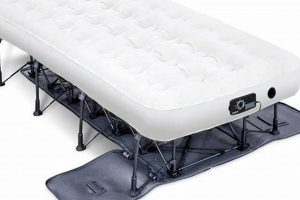
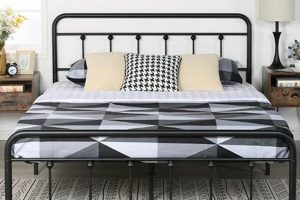
A size disparity exists between queen and full mattresses. The dimensions of a queen mattress are typically 60 inches wide and 80 inches long, whereas a full mattress, also known as a double, measures approximately 54 inches wide and 75 inches long. Consequently, a queen mattress extends beyond the parameters of a full bed frame.
Understanding mattress and frame compatibility is crucial for ensuring proper support, comfort, and the longevity of both the mattress and the frame. An ill-fitting mattress can lead to inadequate support, premature wear and tear, and potentially void warranties. Historically, standardized mattress sizes were developed to simplify manufacturing and facilitate consumer choice.
The subsequent discussion will delve into the specific challenges and potential solutions associated with attempting to accommodate a larger mattress on a smaller frame, as well as explore alternative approaches to achieving optimal sleep arrangements.
Considerations Regarding Mattress and Frame Compatibility
When assessing the feasibility of using a larger mattress with a smaller bed frame, several factors warrant careful evaluation. Addressing these considerations proactively can mitigate potential issues and ensure a stable and supportive sleep environment.
Tip 1: Evaluate Structural Integrity: The primary concern when attempting to place a queen mattress on a full bed frame is the structural capacity of the frame. A frame designed for a smaller mattress may not be able to adequately support the weight and dimensions of a larger one, potentially leading to damage or collapse.
Tip 2: Assess Overhang: The extent of the overhang, the portion of the mattress extending beyond the frame, should be carefully measured. Excessive overhang can create an unstable sleeping surface and pose a safety hazard.
Tip 3: Consider Support Systems: Bed frames utilize various support systems, such as slats or solid platforms. The existing support system on a full bed frame may not be sufficient to adequately support the weight distribution of a queen mattress, leading to sagging or uneven support.
Tip 4: Evaluate Frame Materials: The material composition of the bed frame, whether wood, metal, or a combination, influences its load-bearing capacity. Metal frames generally offer greater strength and durability compared to wooden frames.
Tip 5: Explore Modification Options: In some cases, it may be possible to modify a full bed frame to better accommodate a queen mattress. This could involve adding additional support slats, reinforcing the frame structure, or extending the frame’s dimensions. However, such modifications should be undertaken with caution and professional guidance.
Tip 6: Prioritize Safety: The safety of the sleeping arrangement should be paramount. If the resulting setup feels unstable or presents a risk of collapse, it is advisable to reconsider the arrangement.
Tip 7: Consult Professionals: Seeking advice from furniture experts or mattress retailers can provide valuable insights and recommendations regarding the compatibility of different mattress and frame sizes. Their expertise can help avoid costly mistakes and ensure a safe and comfortable sleep environment.
Adhering to these considerations can assist in making informed decisions about mattress and frame compatibility, prioritizing safety, support, and the long-term integrity of both components.
The subsequent section will address the potential consequences and alternative solutions related to this incompatibility.
1. Size Discrepancy

The fundamental incompatibility between a queen mattress and a full bed frame stems directly from the measurable size discrepancy between the two. A standard queen mattress is dimensionally larger than a full-size mattress; therefore, it’s wider and longer. This difference in dimensions is not merely a minor inconvenience; it is the root cause of the fitting problem. When attempting to place a queen mattress on a full bed frame, the queen mattress will inevitably overhang the edges of the frame. This overhang creates a situation where the mattress is not adequately supported across its entire surface. The degree of overhang, directly related to the six-inch width and five-inch length difference, dictates the severity of the stability and support issues that arise.
The impact of this dimensional mismatch can be observed in practical scenarios. For instance, consider the weight distribution. A mattress designed to distribute weight across a queen-sized area is now concentrated on a smaller full-sized frame. This leads to increased stress on the frame’s supporting structure and the potential for premature wear and tear. Furthermore, the unsupported overhang creates an unstable edge, posing a safety hazard. A person sitting or sleeping near the edge of the mattress may experience a lack of support, potentially leading to falls or discomfort. A real-world example would be a user experiencing back pain over time due to the mattress sagging in areas without frame support.
In conclusion, the size discrepancy is not a negligible factor but rather the definitive reason why a queen mattress is unsuitable for a full bed frame. Its consequences range from compromised comfort and support to potential damage to the frame and safety concerns for the user. A comprehensive understanding of this dimensional incompatibility is crucial for making informed decisions regarding bed frame and mattress selection, ensuring a safe and stable sleeping environment. The assertion that a queen mattress will fit a full bed frame is demonstrably false due to these size differences.
2. Frame Stability

Frame stability is paramount when considering mattress compatibility. An appropriately sized and robust frame is essential for safely and effectively supporting a mattress. The correlation between frame stability and mattress size becomes acutely relevant when evaluating the suitability of placing a queen mattress on a full bed frame.
- Weight-Bearing Capacity
A bed frame’s weight-bearing capacity is a critical aspect of its stability. Full bed frames are engineered to support the weight of a full-size mattress and the occupants of the bed. Placing a queen mattress, which is both larger and potentially heavier, on a full frame can exceed the frame’s design limits. This overextension can lead to structural fatigue, bending, or even complete failure of the frame. An example is a wooden full-size frame designed for a maximum weight limit that is surpassed when a heavier queen mattress and two adults are on the bed, leading to the frame cracking or collapsing over time.
- Load Distribution
Correct load distribution is integral to frame stability. Full bed frames are designed to distribute the weight of a full-size mattress evenly across their support structure. When a queen mattress is placed on a smaller full frame, the weight distribution becomes uneven. The overhang of the queen mattress concentrates weight on the edges of the frame, creating stress points. This can cause the frame to warp or become unstable over time. For instance, the slats on a full-size frame may buckle or break under the concentrated weight of the overhanging queen mattress.
- Joint Integrity
The integrity of the joints that connect the various components of a bed frame is crucial for overall stability. These joints, typically secured with screws, bolts, or adhesive, are vulnerable to stress when a frame is subjected to loads exceeding its design capacity. A queen mattress placed on a full frame puts undue strain on these joints, potentially causing them to loosen or fail. The result could be a wobbly or unstable bed that is prone to collapse. For example, the corner brackets of a full-size metal frame might bend or break due to the increased stress from supporting a queen mattress, leading to a lack of support and increased movement of the bed.
- Material Strength
The material composition of a bed frame directly impacts its strength and stability. Frames constructed from solid hardwoods or reinforced metal are generally more robust than those made from particleboard or lightweight metal. Placing a queen mattress on a full-size frame constructed from weaker materials increases the risk of damage or failure. The frame may not be able to withstand the additional weight and stress, leading to bending, cracking, or collapse. For instance, a full-size bed frame made of particleboard may split or crumble under the weight of a queen mattress, while a metal frame may bend or buckle.
The stability of a bed frame is not simply a matter of aesthetics or convenience; it is a critical safety consideration. Attempting to use a queen mattress on a full bed frame compromises stability due to exceeding the weight-bearing capacity, disrupting load distribution, stressing joint integrity, and potentially overstressing the structural materials. These factors collectively underscore why such a configuration is generally inadvisable and why the assertion that a queen mattress will fit safely and effectively on a full bed frame is fundamentally flawed.
3. Mattress Overhang

Mattress overhang is an inevitable consequence when attempting to place a larger mattress, such as a queen, on a smaller bed frame designed for a full-size mattress. This overhang is not merely an aesthetic issue; it presents significant implications for support, stability, and the overall lifespan of both the mattress and the frame. The degree and nature of the overhang directly correlate to the severity of the ensuing problems.
- Edge Support Compromise
The primary impact of mattress overhang is the compromise of edge support. When a mattress extends beyond the perimeter of the frame, the edges lack the necessary structural foundation. This results in reduced support along the edges, causing the mattress to sag or deform over time. Individuals sitting or sleeping near the edge may experience a feeling of instability or rolling off the bed. For example, a person regularly sitting on the edge of the queen mattress extending over the full-size frame will find that area of the mattress deforms more quickly than the rest of the mattress.
- Uneven Weight Distribution
Mattress overhang disrupts the designed weight distribution intended by both the mattress and frame manufacturers. The mattress is engineered to distribute weight evenly across a specific surface area. When portions of the mattress are unsupported, the weight is concentrated on the areas directly resting on the frame. This uneven distribution can lead to premature wear and tear in those areas, causing indentations, sagging, or even structural damage to the mattress core. Simultaneously, the frame is subjected to localized stress, potentially leading to bending or breakage. For instance, if the center of the mattress is properly supported by the full frame but the edges hang over, the center may wear prematurely due to carrying a disproportionate amount of the load.
- Frame Stress and Instability
The overhang exacerbates stress on the bed frame itself. A frame designed for a smaller mattress may not have the structural capacity to withstand the additional leverage created by the overhanging portion. This added stress can weaken the frame’s joints, causing wobbling, squeaking, or even complete structural failure. The risk is further amplified if the frame is constructed from weaker materials or has inadequate support mechanisms. An example can be seen by looking at the legs of the bed frame – they will show significant signs of strain and possible bending over time.
- Reduced Mattress Lifespan
The combined effects of compromised edge support, uneven weight distribution, and frame stress collectively contribute to a reduced mattress lifespan. The mattress is subjected to unnatural stress patterns and accelerated wear, leading to earlier deterioration of its support structure and comfort layers. This necessitates more frequent mattress replacements, representing a considerable financial burden. For example, a high-quality queen mattress that would normally last 8-10 years may only last 5-6 years if placed on an inappropriately sized full frame.
In conclusion, mattress overhang is a significant concern when considering if a queen mattress will fit on a full bed frame. The resulting lack of support, uneven weight distribution, increased frame stress, and reduced mattress lifespan all underscore the incompatibility of such a setup. Addressing the overhang issue is crucial for ensuring both comfort and the longevity of the sleeping arrangement.
4. Support System

The support system of a bed frame is a critical determinant of its compatibility with a given mattress. When considering the proposition of fitting a queen mattress on a full bed frame, the existing support system of the full frame must be rigorously evaluated for its ability to adequately accommodate the larger mattress.
- Slat Spacing and Strength
The spacing and strength of slats significantly impact the level of support provided to a mattress. Full bed frames typically feature slats designed to support the dimensions and weight distribution of a full-size mattress. Wider slat spacing or weaker slat materials may prove insufficient for a queen mattress, leading to sagging or uneven support. An example involves a full-size frame with slats spaced five inches apart and constructed of thin pine. Placing a queen mattress on this frame could result in the mattress sagging between the slats, particularly in areas bearing significant weight.
- Center Support Rail
A center support rail running lengthwise down the middle of the frame provides crucial reinforcement, particularly for larger mattresses. Many full bed frames lack this feature, as it is not always deemed necessary for supporting a full-size mattress. The absence of a center support rail can exacerbate sagging and instability when a queen mattress is used. Consider a full-size metal frame without a center support. The increased weight of a queen mattress, especially with two occupants, could cause the frame to bow in the middle, leading to discomfort and potential damage to the mattress.
- Platform Construction
Platform beds, which utilize a solid or closely-spaced slatted surface in lieu of traditional slats, offer a more uniform level of support. However, even with a platform design, the overall dimensions of a full-size platform bed remain smaller than those required for a queen mattress. Consequently, overhang and edge support issues still arise. For example, a full-size platform bed, while providing consistent support within its dimensions, will still leave several inches of a queen mattress unsupported around the perimeter, diminishing edge support.
- Foundation Compatibility
The type of foundation used in conjunction with the mattress further influences the overall support system. Box springs, for instance, can provide additional support and elevation. However, placing a queen mattress on a full-size box spring can lead to instability and potential tipping. Similarly, using a foundation designed specifically for a queen mattress on a full-size frame presents the challenge of accommodating the foundation’s larger footprint. An example is attempting to place a queen-size box spring directly on a full-size frame; the overhang would create an unstable and potentially dangerous sleeping surface.
These factors collectively highlight the challenges associated with placing a queen mattress on a full bed frame. The existing support system of the full frame is typically inadequate to properly accommodate the dimensions and weight distribution of the larger mattress, leading to compromised support, instability, and potential damage. This underscores the importance of selecting a bed frame specifically designed to match the size and weight requirements of the chosen mattress.
5. Weight Distribution

Weight distribution is a critical factor to assess when evaluating the feasibility of using a queen mattress on a full bed frame. The designed weight-bearing capacity and structural support of a full frame are specifically calibrated for the dimensions and mass of a full-size mattress. Deviating from this intended configuration significantly alters the distribution of weight, potentially leading to structural compromises and safety concerns.
- Uneven Load Bearing
A queen mattress, being larger than a full-size counterpart, extends beyond the perimeter of a full bed frame. This overhang results in an uneven load-bearing scenario. The central portion of the mattress, resting directly on the frame, bears a concentrated load, while the overhanging edges receive little or no support. This imbalance places undue stress on the frame’s central support structure, potentially leading to bending, warping, or even breakage. For example, the slats of a full bed frame may buckle under the concentrated weight of the central section of the queen mattress, while the edges remain unsupported, creating an unstable sleeping surface.
- Compromised Edge Support
Weight distribution directly affects edge support. A full bed frame is designed to provide consistent support across the entire surface of a full-size mattress. However, when a queen mattress is used, the edges extend beyond the frame, negating this support. This lack of edge support can cause the mattress to sag or deform over time, particularly in areas where occupants frequently sit or sleep. For instance, individuals who habitually sit on the edge of the queen mattress may find that area compresses more rapidly, leading to uneven wear and reduced comfort.
- Increased Frame Stress
The altered weight distribution patterns introduce increased stress on the frame’s joints and connection points. These components, engineered to withstand the loads associated with a full-size mattress, are subjected to greater forces when supporting a queen. This can accelerate wear and tear on the frame, potentially causing loosening, squeaking, or even structural failure. For example, the screws or bolts connecting the headboard and footboard to the side rails may become loose or stripped due to the increased strain, leading to a wobbly and unstable bed frame.
- Mattress Degradation
Uneven weight distribution not only impacts the frame but also the mattress itself. The localized stress on the supported portions of the mattress can cause premature wear and tear in those areas. This uneven compression can lead to indentations, sagging, or a general loss of support, ultimately shortening the mattress’s lifespan. The mattress may also develop pressure points, leading to discomfort or even pain for sleepers. In summary, using an ill-fitting queen mattress can degrade its structural integrity because the full frame is undersized to bear weight properly.
The interplay between weight distribution and the dimensional incompatibility of a queen mattress on a full bed frame reveals a clear challenge. The intended design and structural integrity of both components are compromised when they are mismatched, leading to a cascade of potential issues ranging from frame damage to reduced mattress lifespan and compromised comfort. This underscores the importance of selecting a bed frame that is specifically designed to accommodate the size and weight of the chosen mattress to ensure optimal support, stability, and longevity.
6. Potential Damage
The endeavor to accommodate a queen mattress on a full bed frame introduces a spectrum of potential damage scenarios, affecting both the mattress and the frame. These risks stem from the inherent size disparity and the resultant compromises in support and weight distribution. Recognizing these potential damages is essential for informed decision-making regarding bed and mattress compatibility.
- Frame Structural Failure
The most significant potential damage is structural failure of the full bed frame. Designed to support the dimensions and weight of a full mattress, the frame may lack the necessary strength and stability to accommodate a larger queen. The overhanging edges create leverage, placing undue stress on joints, slats, and support structures. This can lead to bending, cracking, or complete collapse of the frame. For instance, a wooden slat frame may snap under the concentrated weight, or the metal joints may warp, rendering the bed unusable. This damage necessitates costly repairs or complete frame replacement.
- Mattress Degradation and Wear
The unsupported overhang of the queen mattress can cause accelerated degradation and uneven wear. The edges, lacking proper support, are prone to sagging and deformation. This can lead to indentations, loss of firmness, and compromised comfort. Additionally, the mattress core may experience localized stress, leading to internal damage and reduced lifespan. As an example, the coils in an innerspring mattress may become distorted or broken due to the uneven weight distribution, or the foam layers may compress prematurely. This damage diminishes the mattress’s support capabilities and necessitates earlier replacement.
- Joint Loosening and Instability
The increased stress imposed by the larger mattress can loosen the frame’s joints, leading to instability and squeaking. Screws, bolts, and connecting hardware may become stripped or worn, compromising the structural integrity of the frame. This instability can result in a wobbly bed, making it uncomfortable and potentially unsafe. For instance, the headboard or footboard may become detached from the side rails, or the legs of the frame may become loose, creating a tilting effect. Addressing this damage requires tightening or replacing the hardware, potentially incurring repair costs.
- Floor Damage
An unstable bed frame resulting from the mismatched mattress size can also cause damage to the floor. The uneven weight distribution and potential for movement can create pressure points that dent, scratch, or otherwise mar the floor surface. This is particularly relevant for hardwood or laminate floors. For example, the legs of a wobbly bed frame may leave indentations in the floor, or the shifting frame may scratch the finish. Repairing floor damage can be costly and inconvenient.
These potential damage scenarios underscore the inherent risks associated with attempting to use a queen mattress on a full bed frame. The size incompatibility can lead to structural failure, accelerated wear, instability, and even floor damage. By understanding these potential consequences, individuals can make informed decisions that prioritize the longevity and safety of their bedding and furniture. The assertion that a queen mattress will fit and function appropriately on a full bed frame is demonstrably false when considering these risks.
7. Safety Concerns

The attempt to utilize a queen mattress on a full bed frame presents a range of safety concerns stemming from the dimensional incompatibility and compromised structural integrity. These concerns warrant careful consideration to ensure the well-being of individuals using the bed.
- Risk of Collapse
The most critical safety concern is the potential for the bed frame to collapse under the weight of the larger mattress and occupants. A full bed frame is engineered to support a specific weight limit. Exceeding this limit with a queen mattress, which is both larger and potentially heavier, can overstress the frame’s components, leading to structural failure. The risk is amplified if the frame is constructed from weaker materials or lacks adequate support. A collapsing bed frame poses a significant risk of injury to individuals sleeping on the bed.
- Instability and Tipping Hazard
Even if the frame does not collapse entirely, the mismatched mattress size can create instability, increasing the risk of tipping. The overhanging edges of the queen mattress can create an uneven weight distribution, making the bed prone to rocking or tilting, especially when weight is applied to the edges. This instability can lead to falls, particularly for individuals with mobility issues or those who tend to move around during sleep. An unstable bed also presents a hazard for children who may climb or play on it.
- Compromised Edge Support and Falls
The lack of edge support due to mattress overhang increases the risk of falls. The unsupported edges of the queen mattress can sag or deform, creating a less stable sleeping surface. Individuals sitting or sleeping near the edge may experience a feeling of rolling off the bed. This is particularly dangerous for elderly individuals or those with medical conditions that affect balance and coordination. A lack of edge support also makes it more difficult to get in and out of bed safely.
- Entrapment Hazard
In certain scenarios, the gap between the edge of the full bed frame and the overhanging portion of the queen mattress can create an entrapment hazard. Small children or pets may become trapped in this gap, potentially leading to suffocation or injury. The risk is particularly pronounced if the mattress is excessively soft or if there are gaps in the frame’s construction. Regular inspection of the bed and surrounding area is essential to identify and mitigate potential entrapment hazards.
These safety concerns underscore the importance of using a bed frame that is properly sized and designed to support the chosen mattress. The risks associated with attempting to fit a queen mattress on a full bed frame are significant and should not be taken lightly. Prioritizing safety requires adhering to manufacturer recommendations and selecting appropriate bedding components.
Frequently Asked Questions Regarding Mattress and Frame Compatibility
The following frequently asked questions address common concerns and misconceptions regarding the compatibility of a queen mattress with a full bed frame.
Question 1: Is it physically possible to place a queen mattress on a full bed frame?
While it may be physically possible to place a queen mattress on a full bed frame, it is not advisable. The mattress will overhang the edges of the frame, creating instability and compromising support.
Question 2: Will using a queen mattress on a full bed frame void the mattress warranty?
It is possible. Many mattress warranties stipulate that the mattress must be used with a properly sized and supportive frame. Using a frame that is too small may invalidate the warranty.
Question 3: Can a full bed frame be modified to accommodate a queen mattress?
Modifying a full bed frame to fit a queen mattress may be possible, but it is generally not recommended unless undertaken by a qualified professional. Improper modifications can compromise the frame’s structural integrity and safety.
Question 4: What are the potential consequences of using a queen mattress on a full bed frame?
Potential consequences include frame damage, mattress degradation, reduced sleep quality, and safety hazards due to instability.
Question 5: Are there any circumstances in which it is acceptable to use a queen mattress on a full bed frame?
Generally, no. Even in temporary situations, the risks associated with using an improperly sized frame outweigh the convenience. A properly sized frame should be acquired.
Question 6: What are the alternatives to using a queen mattress on a full bed frame?
Alternatives include purchasing a queen-sized bed frame, purchasing a full-sized mattress, or exploring alternative sleeping arrangements.
In summary, attempting to use a larger mattress on a smaller frame presents significant challenges. Prioritizing proper mattress and frame compatibility is essential for ensuring a safe, comfortable, and supportive sleep environment.
The discussion now transitions to summarizing key points and providing concluding remarks on the topic.
Conclusion
The preceding analysis has thoroughly examined the proposition of fitting a queen mattress on a full bed frame. The core argument asserts that such a configuration presents significant challenges due to the dimensional incompatibility, leading to compromised support, instability, potential damage to both the mattress and frame, and notable safety concerns. Key factors, including size discrepancy, frame stability, mattress overhang, support system adequacy, and weight distribution, have been carefully evaluated.
The evidence presented unequivocally demonstrates that attempting to utilize a queen mattress on a full bed frame is ill-advised. Individuals are urged to prioritize the selection of appropriately sized bed frames and mattresses to ensure optimal sleep quality, safety, and longevity of their bedding investment. Adhering to recommended size and weight guidelines remains paramount in establishing a stable and supportive sleeping environment.
![Find Your Perfect Queen Mattress & Bed Frame Set [Deals!] | Organic & Natural Mattress Buyer’s Guide: Non-Toxic Sleep Solutions](https://mattressworldpa.com/wp-content/uploads/2025/07/th-3165-300x200.jpg "Find Your Perfect Queen Mattress & Bed Frame Set [Deals!] Organic & Natural Mattress Buyer’s Guide: Non-Toxic Sleep Solutions")
![Best Extra Long Twin Mattress Frame [Deals!] | Organic & Natural Mattress Buyer’s Guide: Non-Toxic Sleep Solutions](https://mattressworldpa.com/wp-content/uploads/2025/07/th-3164-300x200.jpg "Best Extra Long Twin Mattress Frame [Deals!] Organic & Natural Mattress Buyer’s Guide: Non-Toxic Sleep Solutions")
![Best Bed Frame for Tempurpedic Mattress [Guide 2024] | Organic & Natural Mattress Buyer’s Guide: Non-Toxic Sleep Solutions](https://mattressworldpa.com/wp-content/uploads/2025/07/th-3163-300x200.jpg "Best Bed Frame for Tempurpedic Mattress [Guide 2024] Organic & Natural Mattress Buyer’s Guide: Non-Toxic Sleep Solutions")
![Choosing the Right: Bed Frame, Box Spring, & Mattress [Guide] | Organic & Natural Mattress Buyer’s Guide: Non-Toxic Sleep Solutions](https://mattressworldpa.com/wp-content/uploads/2025/07/th-3162-300x200.jpg "Choosing the Right: Bed Frame, Box Spring, & Mattress [Guide] Organic & Natural Mattress Buyer’s Guide: Non-Toxic Sleep Solutions")