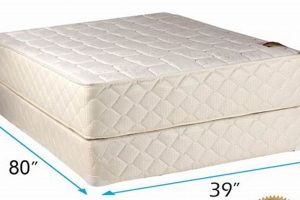
A California King sized mattress, compressed, vacuum-sealed, and packaged for convenient shipping and handling, presents a modern solution to traditional bedding logistics. This type of product simplifies the delivery process, often arriving directly at the consumer’s doorstep via standard carrier services. Upon unboxing, the mattress expands to its full size, ready for use.
This approach to mattress delivery offers several advantages. The reduced shipping size can result in lower transportation costs for both the manufacturer and the consumer. Furthermore, it eliminates the need for specialized delivery services often required for full-sized mattresses, increasing accessibility for individuals in remote locations or those with limited mobility. The technology enabling this compression has evolved significantly over the years, leading to increased confidence in the integrity and comfort of these mattresses.
The subsequent sections will delve into specific aspects, including the types of materials commonly used, considerations for selecting the appropriate firmness level, the expansion process, and long-term care recommendations, providing a thorough understanding of this widely available sleep solution.
Tips for Selecting and Caring for a Compressed California King Mattress
The following recommendations provide guidance when choosing and maintaining a California King mattress delivered in compact packaging, ensuring optimal comfort and longevity.
Tip 1: Research Material Composition. Prioritize mattresses constructed from high-density foam or hybrid designs incorporating innerspring coils. These materials generally offer superior support and durability compared to lower-density alternatives.
Tip 2: Consider Firmness Preferences. Firmness is subjective. Assess individual sleep style and preferred sleeping position. Side sleepers may benefit from a softer surface, while back and stomach sleepers often require firmer support.
Tip 3: Evaluate Expansion Time. Allocate sufficient time for the mattress to fully expand after unboxing, typically between 24 and 72 hours. Verify that the mattress reaches its advertised dimensions and firmness before use.
Tip 4: Invest in Proper Bed Frame Support. Ensure the bed frame provides adequate support across the entire surface of the mattress. Slatted frames should have slats spaced no more than a few inches apart to prevent sagging.
Tip 5: Utilize a Mattress Protector. A waterproof and breathable mattress protector safeguards against spills, stains, and allergens, extending the mattress’s lifespan and maintaining its warranty.
Tip 6: Rotate Regularly. Rotate the mattress every three to six months to promote even wear and prevent indentations. This practice helps maintain consistent comfort and support over time.
Tip 7: Adhere to Cleaning Instructions. Follow the manufacturer’s cleaning instructions for spot cleaning or stain removal. Avoid harsh chemicals or excessive moisture, which can damage the mattress materials.
By considering these factors, individuals can select and maintain a compressed California King mattress that provides comfortable and restorative sleep for years to come.
The final section will summarize the key aspects discussed, emphasizing the overall value proposition of this type of bedding solution.
1. Size and Dimensions

The precise size and dimensions of a compressed California King mattress are critical considerations for consumers. While the mattress is packaged in a significantly smaller form factor, the ultimate goal is to achieve the standard California King dimensions upon full expansion. Any deviation from these expected dimensions can impact the fit within a designated bed frame and affect overall sleep quality.
- Compressed Size and Shipping Constraints
The dimensions of the packaged mattress directly influence shipping costs and handling ease. A more compact package generally translates to lower shipping fees and greater convenience for transport and delivery to the consumer’s residence. The packaging method itself, often involving vacuum sealing and tight rolling, must preserve the integrity of the materials while minimizing volume. If not done properly this can impact the long term use of the mattress.
- Expansion to Standard California King Dimensions
After unboxing, the mattress must expand to the standard California King size, which is 72 inches wide and 84 inches long. The accuracy of this expansion is crucial; a mattress that fails to reach these dimensions may not provide adequate support or fit properly on the intended bed frame. Measuring the mattress after the recommended expansion period is essential to confirm proper size attainment.
- Impact of Materials on Dimensional Stability
The type of materials used in the mattress construction significantly impacts its ability to expand accurately and maintain its dimensions over time. High-density foams and quality innerspring systems tend to exhibit greater dimensional stability compared to lower-quality materials. Material elasticity is essential for consistent expansion and long-term performance. Cheaper materials may not always return to the proper form, or expand at all.
- Bed Frame Compatibility
The ultimate dimensions of the fully expanded mattress must align with the bed frame designed for a California King size. Incompatibility between the mattress and frame can result in inadequate support, premature wear, or even potential damage to the mattress. Verifying compatibility is essential before purchasing or using a compressed mattress.
The interplay between the compressed and expanded sizes, coupled with the material’s impact on dimensional stability, determines the overall value and suitability of a compressed California King mattress. Prioritizing mattresses with well-defined specifications and a proven track record of accurate expansion is essential for a positive consumer experience.
2. Material Composition

The material composition of a compressed California King mattress directly influences its performance characteristics and longevity. The compression process places significant stress on the internal structure of the mattress; therefore, the choice of materials becomes paramount. Inferior materials may exhibit permanent deformation or diminished support after compression and subsequent expansion. For example, low-density foams are more susceptible to compression-induced damage than high-density alternatives. The selection of materials predetermines the success of the product’s design concept.
Common materials found in compressed mattresses include memory foam, polyurethane foam, latex, and innerspring coils. Each material contributes unique properties to the overall mattress performance. Memory foam offers pressure relief and contouring, while polyurethane foam provides support and resilience. Latex boasts natural elasticity and durability, and innerspring coils offer traditional support and airflow. Hybrid mattresses combine multiple materials to leverage their individual strengths. To illustrate, a compressed California King mattress with a hybrid design might incorporate a layer of high-density memory foam for comfort, a layer of pocketed coils for support, and a durable polyurethane foam base for stability.
Ultimately, the material composition of a compressed California King mattress defines its comfort level, support capabilities, durability, and resistance to long-term deformation. Understanding the properties of each material is essential for making informed purchasing decisions. Consumers should prioritize mattresses constructed from high-quality materials designed to withstand the rigors of compression and expansion, ensuring a comfortable and supportive sleep surface for years to come.
3. Firmness Options
The availability of varying firmness options is a critical component of the “cal king mattress in a box” product category. The compression and subsequent expansion process does not negate the need for customized comfort. Rather, it necessitates careful consideration of how different firmness levels are achieved through specific material combinations and construction techniques. Without these options, a “cal king mattress in a box” risks becoming a one-size-fits-all solution, failing to cater to the diverse sleeping preferences of consumers. A real-life example is a side sleeper needing a softer surface to alleviate pressure on their shoulders and hips, versus a back sleeper requiring a firmer surface for spinal alignment; each necessitates a different firmness selection.
The firmness of a compressed California King mattress directly impacts its suitability for various sleeping styles and body types. Firmer options generally offer greater support and are well-suited for individuals who sleep on their stomach or back, or those who weigh more. Softer options, conversely, provide increased pressure relief and are often preferred by side sleepers or lighter individuals. Manufacturers achieve varying firmness levels by manipulating the density and type of foam layers, as well as the gauge and configuration of innerspring coils, if present. The practicality lies in the consumer’s ability to choose a mattress that corresponds with their specific needs. Some companies even offer trial periods so consumers can test their chosen firmness at home.
In summary, firmness options are essential for the success and widespread adoption of the “cal king mattress in a box” concept. It allows manufacturers to offer a personalized sleep experience despite the constraints of compression and shipping. The challenge lies in accurately conveying firmness levels to consumers through online descriptions and ensuring consistent quality across different firmness choices. Understanding firmness options in relation to material and design is necessary for a consumer to make an informed purchase, resulting in increased satisfaction and better sleep.
4. Compression Technology
Compression technology is a foundational element of the “cal king mattress in a box” concept, enabling the efficient packaging and transportation of a traditionally bulky item. Without advancements in this area, the feasibility and cost-effectiveness of delivering a fully-sized mattress directly to the consumer would be significantly compromised. Understanding the nuances of these techniques is essential to appreciating the innovation behind this modern bedding solution.
- Vacuum Sealing Techniques
Vacuum sealing represents a crucial first step, removing air from the mattress to reduce its overall volume. Industrial-grade vacuum chambers are employed to compress the mattress, followed by the application of airtight seals to maintain the compressed state. This process is analogous to food preservation techniques, preventing re-expansion and facilitating compact packaging. The success of this method hinges on the quality of the sealing materials and the precision of the vacuuming process.
- Rolling and Folding Methods
Following vacuum sealing, mattresses are often rolled or folded to further minimize their dimensions for packaging. Specialized machinery ensures uniform compression and prevents damage to the internal structure of the mattress. The rolling technique is particularly common for mattresses containing foam layers, while folding may be employed for hybrid models incorporating innerspring coils. These methods are similar to how textiles and other compressible materials are prepared for shipment, but require adaptations to accommodate the unique properties of mattress materials.
- Material Resilience and Recovery
The effectiveness of compression technology depends heavily on the ability of mattress materials to rebound to their original shape after unboxing. High-density foams and resilient innerspring systems are crucial for ensuring proper expansion and long-term performance. Materials lacking sufficient elasticity may exhibit permanent deformation or diminished support capabilities. This is a critical consideration for manufacturers when selecting components for “cal king mattress in a box” products, requiring rigorous testing and quality control to ensure consistent performance.
- Packaging Integrity and Protection
The outer packaging plays a vital role in protecting the compressed mattress from damage during transit. Durable materials, such as reinforced cardboard and protective plastic wraps, are employed to withstand the rigors of shipping and handling. Proper packaging design also minimizes the risk of punctures or tears that could compromise the vacuum seal and allow the mattress to expand prematurely. The design philosophy hinges on protecting the compressed state of the mattress until the point of consumer use. Some boxes use layers of protection.
These facets of compression technology, while seemingly distinct, are intrinsically linked in the context of “cal king mattress in a box.” The integration of efficient vacuum sealing, controlled rolling techniques, resilient materials, and robust packaging is essential for delivering a high-quality product that meets consumer expectations. Any weakness in one of these areas can compromise the overall effectiveness of the compression process and negatively impact the consumer experience.
5. Delivery Convenience

The connection between delivery convenience and a “cal king mattress in a box” is fundamentally causal. The design and packaging innovations inherent in a compressed mattress directly enable simplified shipping and handling. This is because the reduced size and weight, compared to a traditional, uncompressed mattress, allow for transport via standard carriers, eliminating the need for specialized freight services. The practical effect is lower shipping costs and greater accessibility for consumers, particularly those in remote areas or with limited mobility. Without the compression technology, the delivery of a California King mattress would remain a logistical challenge, often involving scheduling difficulties and increased expenses. As an example, a customer living in an apartment building without a freight elevator benefits significantly from the ease with which a “cal king mattress in a box” can be carried and maneuvered.
The importance of delivery convenience as a component of a “cal king mattress in a box” cannot be overstated. It is a primary driver of consumer adoption and a key differentiator in a competitive market. Real-life examples highlight this point: consider the elderly individual who can avoid the hassle of coordinating in-home delivery, or the busy professional who appreciates the flexibility of receiving the mattress during standard package delivery hours. The value proposition extends beyond mere convenience; it translates to time savings, reduced stress, and greater control over the purchasing process. Furthermore, the ability to ship directly to the consumer minimizes the need for brick-and-mortar stores to maintain large inventories, streamlining the supply chain and potentially reducing overall product costs.
In summary, the delivery convenience afforded by the “cal king mattress in a box” is not simply an added benefit; it is an integral design feature that directly influences the customer experience. Understanding this relationship is crucial for manufacturers seeking to optimize their product offerings and distribution strategies. While challenges remain in ensuring consistent delivery timelines and minimizing potential shipping damage, the inherent advantages of a compressed mattress in terms of ease of transport and accessibility underscore its significance in the modern bedding market.
6. Expansion Process

The expansion process represents a critical phase in the lifecycle of a “cal king mattress in a box,” dictating the ultimate comfort and usability of the product. The integrity of the entire concept hinges on the mattress’s ability to fully and accurately decompress from its compressed state to its intended dimensions and firmness. The intricacies of this phase warrant detailed examination, as various factors can influence the outcome.
- Initial Unboxing and Air Exposure
Upon unboxing, the mattress is exposed to air, initiating the decompression process. The rate of expansion is influenced by ambient temperature, humidity, and the mattress’s material composition. Manufacturers typically recommend allowing a specific timeframe, often ranging from 24 to 72 hours, for complete expansion. Inadequate air circulation can impede the process, potentially leading to uneven expansion or lingering compression artifacts.
- Dimensional Recovery and Conformity
The mattress must expand to its specified California King dimensions (72 inches wide and 84 inches long) to ensure proper fit within a compatible bed frame. Incomplete or uneven expansion can result in dimensional discrepancies, compromising support and comfort. Regular measurements during the expansion period are advisable to monitor progress and identify potential issues. The materials play a key role in returning to dimensions.
- Off-Gassing and Odor Dissipation
During expansion, some mattresses may release volatile organic compounds (VOCs), resulting in a noticeable odor. This phenomenon, known as off-gassing, is generally harmless and dissipates over time. Adequate ventilation of the room can accelerate odor dissipation. While some level of off-gassing is common, excessive or persistent odors may indicate the presence of low-quality materials.
- Firmness Stabilization and Break-in Period
The initial firmness of a newly expanded mattress may differ from its intended long-term firmness. A break-in period, typically lasting several weeks, allows the materials to fully settle and achieve their designed comfort level. Regular use and rotation of the mattress can promote even settling and prevent localized depressions. Initial impressions should be interpreted with the understanding that firmness may evolve over time.
The successful completion of the expansion process is paramount to realizing the full potential of a “cal king mattress in a box.” Addressing potential challenges related to air exposure, dimensional recovery, off-gassing, and firmness stabilization ensures a positive consumer experience and maximizes the longevity and performance of the mattress. Therefore, careful adherence to manufacturer guidelines and proactive monitoring during the expansion phase are essential.
Frequently Asked Questions
This section addresses common inquiries regarding compressed California King mattresses, providing clarity on key features and potential concerns.
Question 1: How does the compression process affect the long-term durability of a California King mattress in a box?
The impact on durability depends on the quality of materials and compression techniques employed. Higher-density foams and robust innerspring systems generally exhibit greater resilience after compression. Reputable manufacturers utilize methods designed to minimize stress on internal components, preserving the mattress’s structural integrity.
Question 2: Is off-gassing a significant concern with compressed California King mattresses?
Some degree of off-gassing is common with mattresses containing foam, regardless of compression. VOCs are released as the materials decompress. Adequate ventilation during the initial expansion period typically mitigates any potential discomfort. Certifications such as CertiPUR-US indicate that the mattress meets specific emissions standards.
Question 3: Will a compressed California King mattress fully expand to its advertised dimensions?
Full expansion is contingent on following the manufacturer’s instructions and allowing sufficient time for decompression, typically 24 to 72 hours. Factors such as ambient temperature and humidity can influence the expansion rate. If the mattress fails to reach its specified dimensions, contacting the manufacturer is advised.
Question 4: How does the firmness of a compressed California King mattress compare to that of a traditional mattress?
The firmness rating should be consistent regardless of the compression process. However, a new mattress may initially feel slightly firmer until it fully settles. Reviewing customer feedback and understanding the manufacturer’s firmness scale is crucial for informed selection.
Question 5: Is a compressed California King mattress suitable for all bed frames?
The fully expanded mattress should be compatible with any standard California King bed frame. Ensuring adequate support across the entire surface is essential to prevent sagging and premature wear. Slatted frames should have slats spaced no more than a few inches apart.
Question 6: What is the typical warranty period for a compressed California King mattress?
Warranty periods vary among manufacturers, ranging from several years to a decade or more. Reviewing the warranty terms and conditions is crucial for understanding the scope of coverage, including potential limitations and exclusions.
Understanding these aspects of compressed California King mattresses aids in making an educated purchasing decision.
The following section will provide a comparative analysis of different brands and models, highlighting key features and performance metrics.
Conclusion
The preceding analysis provides a comprehensive overview of the “cal king mattress in a box,” encompassing material composition, firmness options, compression technology, delivery convenience, the expansion process, and addressing common consumer inquiries. The viability of this bedding solution hinges on the confluence of advanced manufacturing techniques and robust quality control measures. The exploration into this topic showed a better understanding of what a cal king mattress in a box is.
Consideration of the outlined factors, coupled with diligent product research, enables informed purchasing decisions. As the market evolves, continued innovation in materials and compression methodologies will further enhance the performance and accessibility of the compressed California King mattress, solidifying its position as a viable alternative to traditional bedding options. Continued attention to this product will lead to more innovative solution in the fututre.
![Upgrade Your Sleep: Twin Mattress & Box Spring Set - [Year] | Organic & Natural Mattress Buyer’s Guide: Non-Toxic Sleep Solutions](https://mattressworldpa.com/wp-content/uploads/2025/07/th-3528-300x200.jpg "Upgrade Your Sleep: Twin Mattress & Box Spring Set - [Year] Organic & Natural Mattress Buyer’s Guide: Non-Toxic Sleep Solutions")