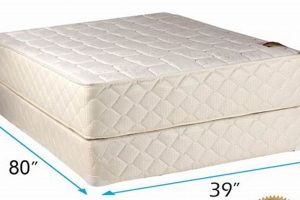
A sleeping surface designed for direct placement on a bed frame or the floor, eliminating the need for a traditional box spring, offers a streamlined and often more affordable bedding solution. Examples include memory foam, latex, and hybrid mattresses specifically engineered with sufficient support for stand-alone use. These mattresses maintain proper spinal alignment and comfort without relying on the additional support provided by a box spring.
The advantage of this bedding choice lies in its versatility and cost-effectiveness. It provides compatibility with platform beds, adjustable bases, and even floor placement, creating diverse aesthetic and functional options. Historically, box springs were essential for innerspring mattresses, but advancements in mattress construction now allow for durable and comfortable support without the need for this additional component. This evolution reduces overall bed height, creating a more contemporary profile and often simplifying the purchasing process.
The selection of an appropriate stand-alone mattress requires careful consideration of factors such as firmness, material composition, and support structure. Assessing individual sleep preferences and body weight ensures optimal comfort and longevity. Further research into specific mattress types and their suitability for various bed frame designs is recommended before making a purchase decision.
Selecting a Mattress Designed for Box Spring-Free Use
The following tips provide guidance for choosing a mattress engineered for optimal performance without a box spring, ensuring longevity and support.
Tip 1: Evaluate Support System: Prioritize mattresses with robust internal support structures, such as high-density foam cores or individually wrapped coils. These features compensate for the absence of a box spring’s support.
Tip 2: Consider Mattress Thickness: Opt for a mattress with sufficient thickness, typically 10 inches or greater, to provide adequate cushioning and prevent sagging over time when used directly on a platform or the floor.
Tip 3: Assess Platform Bed Compatibility: When pairing with a platform bed, verify the platform’s slat spacing. Slats should be no more than 3 inches apart to prevent mattress deformation or voiding of warranty.
Tip 4: Review Material Density: Higher density foams, particularly in memory foam and latex mattresses, offer enhanced durability and resistance to compression, maintaining consistent support throughout the mattress’s lifespan.
Tip 5: Investigate Edge Support: Strong edge support is crucial for preventing roll-off and maximizing the usable sleep surface when a box spring is not present. Look for reinforced edges or perimeter coils.
Tip 6: Check Warranty Requirements: Confirm the mattress warranty’s terms regarding box spring usage. Some manufacturers may void the warranty if the mattress is used without proper support.
Tip 7: Read Customer Reviews: Research user experiences specifically related to the mattress’s performance on platform beds or without a box spring. Feedback from other consumers can provide valuable insights.
Selecting a stand-alone mattress requires careful consideration of its internal structure and support capabilities. Paying attention to these elements will ensure a comfortable and durable sleep surface.
The following section explores different mattress types suitable for use without a box spring and their corresponding advantages.
1. Support and Durability

Support and durability are paramount when considering mattresses designed for use without a box spring. The absence of a box spring necessitates that the mattress itself provides all necessary support to maintain proper spinal alignment and prevent premature sagging. Inadequate support can lead to discomfort, pain, and a shortened lifespan of the mattress. A mattress constructed with high-density foam or robust coil systems can better withstand nightly use and resist compression, therefore maintaining its shape and supportive qualities over time. For instance, a memory foam mattress with a high-density base layer is less likely to develop impressions than one with a low-density base, especially when placed directly on a platform bed.
The practical significance of robust support and durable materials extends to the overall value proposition of the mattress. A less durable mattress may require replacement sooner, negating any initial cost savings. The longevity of a mattress lacking a box spring depends entirely on the quality of its internal components and construction. The support system directly influences sleep quality. A sagging or unsupportive mattress can disrupt sleep cycles and contribute to long-term discomfort. Mattresses utilizing individually wrapped coils or advanced foam layering techniques often demonstrate superior contouring and weight distribution, further enhancing support and mitigating pressure points.
In summary, support and durability are fundamental attributes that dictate the overall performance and lifespan of a mattress intended for box spring-free use. Ensuring these qualities are prioritized will result in a more comfortable, healthier, and ultimately more cost-effective sleep solution. Compromising on these elements can lead to dissatisfaction, discomfort, and the need for premature replacement. Selecting a mattress with a proven track record of durability and a design focused on adequate support is essential for a successful transition away from traditional box spring setups.
2. Platform Bed Compatibility
Platform bed compatibility is a crucial determinant when selecting a mattress designed for use without a box spring. A platform bed, characterized by its solid or slatted support surface, necessitates a mattress capable of providing adequate comfort and support independently. Mattresses not designed for direct platform placement may exhibit premature wear, sagging, or inconsistent support, diminishing sleep quality and potentially voiding manufacturer warranties. For example, an innerspring mattress with widely spaced coils may sag between platform slats, while a memory foam mattress lacking sufficient density may compress unevenly. The importance of compatibility stems from the direct interaction between the mattress and the platform surface; the mattress must distribute weight effectively across this surface to maintain its structural integrity and provide consistent support.
Practical applications of understanding platform bed compatibility extend to ensuring proper ventilation and preventing moisture buildup. Some platform beds offer minimal airflow, potentially leading to mold or mildew growth within the mattress. Therefore, selecting a mattress with breathable materials, such as latex or open-cell memory foam, becomes critical. Furthermore, the spacing of the platform bed slats impacts mattress support. Slats positioned too far apart can create unsupported gaps, leading to mattress deformation. Conversely, closely spaced slats provide a more uniform surface, enhancing support and prolonging the mattress’s lifespan. A hybrid mattress with individually pocketed coils and a dense foam layer often performs well on platform beds due to its balanced support and adaptability.
In conclusion, platform bed compatibility is inextricably linked to the overall performance and longevity of a mattress designed for box spring-free use. Selecting a mattress that is specifically engineered to function effectively on a platform bed ensures optimal support, prevents premature wear, and promotes a healthy sleep environment. Overlooking this critical factor can lead to diminished sleep quality, reduced mattress lifespan, and potential warranty issues. Therefore, verifying compatibility is essential for maximizing the benefits of a platform bed setup.
3. Mattress Thickness

Mattress thickness plays a pivotal role in determining the suitability of a mattress for use without a box spring. The overall height and composition of the mattress layers directly influence its support capabilities, comfort level, and longevity when placed directly on a platform bed or the floor.
- Support Core Depth
The depth of the support core, typically consisting of high-density foam or innerspring coils, dictates the mattress’s ability to maintain spinal alignment and resist sagging. A thicker support core provides greater resistance to compression, ensuring consistent support over time. For example, a mattress with an 8-inch high-density foam base is generally more supportive than one with a 4-inch base, particularly for heavier individuals. This is especially critical when the mattress rests directly on a solid surface, as the core must bear the entire load without the assistance of a box spring.
- Comfort Layer Thickness
The comfort layer, composed of materials such as memory foam, latex, or fiberfill, provides cushioning and pressure relief. A thicker comfort layer enhances the mattress’s ability to conform to the body’s contours, reducing pressure points and improving sleep quality. However, excessive comfort layer thickness without adequate support can lead to a lack of stability and a feeling of sinking into the mattress. An appropriate balance between comfort and support layers is necessary for optimal performance. Mattresses designed for box spring-free use often feature a thicker comfort layer to compensate for the absence of a traditional spring system.
- Edge Support Reinforcement
Mattress thickness contributes to edge support, which is essential for preventing roll-off and maximizing the usable sleep surface. A thicker mattress, particularly one with reinforced edges, offers greater stability and prevents the edges from collapsing under weight. This is especially important for individuals who sleep near the edge of the bed or require assistance getting in and out of bed. Edge support reinforcement can be achieved through the use of high-density foam encasements or strategically placed coils around the perimeter of the mattress. A thicker mattress allows for more robust edge support construction.
- Overall Height Considerations
The overall height of the mattress impacts ease of access and aesthetics. A thicker mattress can raise the sleep surface to a more comfortable height, particularly when used with a low-profile platform bed. However, excessively thick mattresses may be difficult to maneuver and may not be compatible with all bed frames. When selecting a mattress without a box spring, consider the desired bed height in relation to personal preferences and physical limitations. A balanced approach ensures both comfort and practicality.
In summary, mattress thickness is a critical factor to consider when selecting a mattress designed for box spring-free use. The depth of the support core, the thickness of the comfort layer, the presence of edge support reinforcement, and overall height considerations all contribute to the mattress’s performance and suitability for direct placement on a platform or the floor. Prioritizing these aspects ensures a comfortable, supportive, and durable sleep experience.
4. Edge Support
Edge support is a critical attribute of a mattress engineered for use without a box spring. The absence of a box spring necessitates that the mattress itself provides sufficient stability across its entire surface, including the perimeter. Weak or inadequate edge support leads to a compromised sleep surface, characterized by a sensation of roll-off and reduced usable sleeping area. For instance, an individual sleeping near the edge of a mattress lacking sufficient edge support may experience discomfort and instability, potentially disrupting sleep. This is further exacerbated when sitting on the edge of the bed, such as while dressing, as the lack of support can cause the mattress to compress significantly, leading to discomfort and potential damage over time. The importance of robust edge support directly correlates to the overall comfort and usability of the mattress, particularly in the absence of a supporting box spring.
Practical applications of understanding edge support extend to assessing a mattress’s suitability for individuals sharing a bed or those with mobility limitations. A mattress with strong edge support allows couples to utilize the full width of the bed without experiencing a sinking sensation near the edges. This is particularly beneficial for maximizing sleeping space and minimizing sleep disturbances. Additionally, robust edge support facilitates easier entry and exit from the bed, providing a stable surface for individuals with mobility challenges or those requiring assistance. Mattresses incorporating reinforced edge coils or high-density foam encasements offer enhanced edge support, distributing weight more evenly and preventing premature wear along the perimeter. The selection of such features directly contributes to the mattress’s long-term performance and user satisfaction.
In conclusion, edge support is an indispensable element of mattresses designed for box spring-free use. It significantly impacts sleep quality, usable surface area, and overall mattress longevity. Selecting a mattress with robust edge support features ensures a stable and comfortable sleeping surface, maximizing the benefits of eliminating the traditional box spring. Neglecting this critical aspect can result in a compromised sleep experience and a reduced lifespan for the mattress. Therefore, prioritizing edge support is essential for achieving optimal satisfaction and value from a mattress intended for direct placement on a platform or the floor.
5. Warranty Terms

Warranty terms are a critical consideration when selecting a mattress designed for use without a box spring. The absence of a traditional box spring places greater emphasis on the mattress’s inherent structural integrity and support capabilities. Therefore, the warranty acts as a safeguard, protecting the consumer against manufacturing defects and premature degradation of the mattress’s performance. Some mattress manufacturers explicitly require the use of a box spring to validate the warranty, while others offer warranties that are applicable regardless of the foundation used. Understanding these stipulations is crucial to avoid potential disputes and ensure coverage in the event of mattress failure. A common cause for warranty denial is visible sagging or impressions exceeding a specified depth, often attributed to inadequate support if a box spring was not used when the warranty mandates it.
Practical implications of warranty terms are extensive. Consider the scenario where a consumer purchases a high-end memory foam mattress, intending to use it directly on a platform bed. If the warranty specifies box spring use, any subsequent sagging or structural failure may not be covered, leaving the consumer with the burden of repair or replacement costs. Conversely, a mattress with a warranty that explicitly permits box spring-free use provides greater peace of mind and protection against unforeseen issues. Furthermore, the length and scope of the warranty can indicate the manufacturer’s confidence in the product’s durability. A longer warranty typically suggests higher-quality materials and construction techniques. Careful examination of warranty exclusions, such as damage caused by improper support, is essential to ensure compliance and maintain warranty validity.
In summary, warranty terms are an integral component of the decision-making process when selecting a stand-alone mattress. The warranty’s stipulations regarding box spring usage directly impact the consumer’s rights and recourse in the event of mattress failure. Thoroughly reviewing and understanding the warranty terms ensures that the selected mattress aligns with the intended usage and provides adequate protection against potential defects or premature wear. Ignoring these terms can lead to unexpected expenses and dissatisfaction, underscoring the importance of prioritizing warranty considerations when choosing a mattress designed for use without a box spring.
Frequently Asked Questions
The following frequently asked questions address common inquiries and concerns regarding mattresses specifically engineered for use without a box spring, providing clarity and dispelling misconceptions.
Question 1: Does a mattress designed for box spring-free use require a specific type of bed frame?
While these mattresses are versatile, optimal performance is typically achieved with platform beds featuring closely spaced slats (no more than 3 inches apart) or solid surfaces. Adjustable bases are also generally compatible. Incompatible bed frames or inadequate support can compromise the mattress’s structural integrity and potentially void the warranty.
Question 2: How does a mattress designed for box spring-free use differ from a traditional mattress?
The primary difference lies in the internal support structure. These mattresses are constructed with robust support cores (e.g., high-density foam or individually wrapped coils) designed to provide adequate support without the supplementary support of a box spring. Traditional mattresses often rely on a box spring for optimal performance and longevity.
Question 3: Is a mattress designed for box spring-free use suitable for all sleep positions?
Suitability depends on the mattress’s firmness and construction. Side sleepers often prefer softer mattresses that contour to the body, while back and stomach sleepers typically require firmer mattresses for spinal alignment. Evaluating individual sleep preferences and body weight is crucial for selecting an appropriate mattress.
Question 4: Does a mattress designed for box spring-free use have a shorter lifespan than a traditional mattress?
Lifespan depends on the mattress’s quality, materials, and usage. Mattresses constructed with high-density materials and robust support systems can provide comparable or even extended lifespans compared to traditional mattresses. Proper maintenance, such as regular rotation, can also prolong the mattress’s usability.
Question 5: Can a mattress designed for box spring-free use be used on the floor?
While possible, placing a mattress directly on the floor can impede airflow and potentially lead to moisture buildup and mold growth. Regularly elevating the mattress for ventilation is recommended. Using a platform bed or a slatted foundation is generally a preferred alternative for improved hygiene and longevity.
Question 6: Are mattresses designed for box spring-free use more expensive than traditional mattresses?
Price varies depending on the mattress type, materials, and brand. While some may be more expensive due to advanced construction techniques, the elimination of the box spring can offset the initial cost, resulting in a potentially more economical overall bedding solution.
In summary, mattresses designed for box spring-free use offer a versatile and often cost-effective alternative to traditional bedding setups. However, careful consideration of bed frame compatibility, support structure, and warranty terms is essential for ensuring optimal performance and longevity.
The subsequent section provides guidance on selecting the optimal mattress type for box spring-free use, highlighting the specific benefits and considerations associated with each option.
Concluding Remarks on Stand-Alone Mattress Selection
This examination of the “best mattress without box spring” demonstrates the importance of considering support systems, platform compatibility, thickness, edge reinforcement, and warranty stipulations. The absence of a box spring places greater emphasis on the mattress’s inherent ability to provide adequate support, distribute weight effectively, and maintain structural integrity over time. Each aspect contributes significantly to the overall comfort, durability, and longevity of the sleep surface.
The selection of a suitable mattress absent a box spring requires diligent research and a comprehensive understanding of individual sleep needs and preferences. Failing to prioritize these elements can result in a compromised sleep experience and potentially lead to premature mattress degradation. Therefore, informed decision-making is crucial for optimizing long-term satisfaction and maximizing the value of this bedding investment.
![Upgrade Your Sleep: Twin Mattress & Box Spring Set - [Year] | Organic & Natural Mattress Buyer’s Guide: Non-Toxic Sleep Solutions](https://mattressworldpa.com/wp-content/uploads/2025/07/th-3528-300x200.jpg "Upgrade Your Sleep: Twin Mattress & Box Spring Set - [Year] Organic & Natural Mattress Buyer’s Guide: Non-Toxic Sleep Solutions")