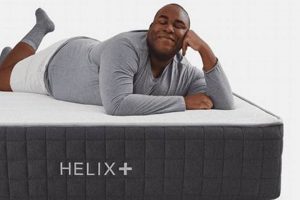
The selection of appropriate sleep surfaces for individuals with higher body weights is a crucial consideration for ensuring restful sleep and promoting overall well-being. This specific category addresses the unique support and comfort requirements of this demographic, taking into account factors like mattress firmness, construction materials, and edge support. For example, a mattress designed for this purpose often features reinforced coils and high-density foam to prevent sagging and provide consistent support across the entire surface.
Proper support and pressure relief contribute significantly to improved sleep quality, reduced back pain, and enhanced spinal alignment. Historically, standard mattresses often lacked the necessary structural integrity to adequately support individuals with higher body weights, leading to discomfort and premature mattress degradation. The development of mattresses specifically engineered to meet these needs represents a significant advancement in sleep technology, promoting better health outcomes and increased user satisfaction.
The following sections will delve into the specific characteristics of suitable mattresses, exploring material science, construction techniques, and key features to consider when making a purchase decision, ultimately empowering informed choices that prioritize sleep health and longevity.
Selecting the Appropriate Mattress
This section provides guidance on making informed purchasing decisions, focusing on key mattress characteristics that ensure optimal support and longevity for individuals with higher body weights.
Tip 1: Prioritize Mattress Firmness. A firmer mattress generally offers better support and prevents excessive sinking, maintaining proper spinal alignment. Look for models specifically rated as “firm” or “extra firm.”
Tip 2: Investigate Core Construction. Innerspring mattresses with a high coil count and reinforced coils are recommended. Pocketed coils, which move independently, can minimize motion transfer and provide targeted support.
Tip 3: Examine Material Density. High-density foams, particularly in the comfort layers and support core, offer superior durability and resistance to compression. Memory foam with a density of at least 5 lbs/cubic foot is often preferred.
Tip 4: Consider Hybrid Options. Hybrid mattresses, combining innerspring systems with layers of foam or latex, can offer a balance of support, comfort, and temperature regulation.
Tip 5: Evaluate Edge Support. Reinforced edges prevent sagging and provide a stable surface for sitting or sleeping near the edge of the mattress. Look for mattresses with edge reinforcement systems.
Tip 6: Check Weight Capacity. Confirm the mattress’s stated weight capacity to ensure it is appropriate for the intended user. Exceeding the weight limit can compromise support and shorten the mattress’s lifespan.
Tip 7: Research Reputable Brands. Opt for established mattress brands known for their quality, durability, and warranty coverage. Read reviews and compare specifications before making a purchase.
Adhering to these recommendations will significantly increase the likelihood of selecting a sleep surface that provides adequate support, promotes proper spinal alignment, and ensures long-term comfort.
The subsequent sections will explore specific mattress types and features in greater detail, providing a comprehensive overview of available options.
1. Firmness

Firmness is a critical determinant in the selection of an appropriate sleep surface for individuals with a higher body weight. The relationship between firmness and support is linear: insufficient firmness results in excessive compression of the mattress, leading to spinal misalignment and increased pressure on specific body points. This misalignment can cause or exacerbate back pain, disrupt sleep patterns, and contribute to musculoskeletal discomfort. Conversely, adequate firmness ensures that the spine remains properly aligned throughout the night, promoting healthy posture and reducing the risk of pain and discomfort.
The impact of firmness is evident in real-world scenarios. For instance, an individual with a body mass index (BMI) exceeding 30 using a plush mattress is likely to experience significant sinking, causing the spine to curve unnaturally. This contrasts sharply with the experience on a firmer mattress, which distributes weight more evenly and prevents excessive compression. The correct level of firmness also provides a more stable surface for movement, reducing the effort required to change positions during sleep and minimizing sleep disturbances. Furthermore, a firmer mattress maintains its structural integrity over time, providing consistent support and preventing premature sagging, which is a common issue with softer mattresses under higher weight loads.
In summary, firmness serves as a foundational element in delivering effective support and ensuring a comfortable sleep environment. Selection of a mattress with appropriate firmness is crucial for optimizing spinal alignment, reducing pressure points, and enhancing sleep quality. Addressing the need for adequate firmness is a primary consideration when seeking a long-lasting sleep solution for individuals with higher body weights, directly influencing long-term comfort and well-being.
2. Support

Support, in the context of mattresses designed for individuals with higher body weights, is a paramount characteristic dictating spinal alignment, pressure distribution, and overall sleep quality. Insufficient support leads to mattress sagging, improper posture, and increased risk of musculoskeletal issues. Therefore, a robust support system is fundamental to ensuring restorative sleep and long-term comfort.
- Core Reinforcement
The mattress core, often composed of innerspring coils or dense foam, provides the primary structural support. Reinforced coils, typically featuring thicker gauge steel, enhance weight-bearing capacity and prevent premature coil fatigue. Similarly, high-density foam cores resist compression, maintaining a consistent level of support across the mattress surface. Example: A hybrid mattress with individually wrapped coils and a high-density polyfoam base demonstrates excellent core reinforcement, accommodating higher weights without significant sagging. The absence of adequate core reinforcement invariably leads to diminished support and a shorter mattress lifespan.
- Zoned Support Systems
Zoned support systems incorporate varying levels of firmness across different sections of the mattress to accommodate different body regions. Firmer support under the lumbar region, for instance, promotes spinal alignment and alleviates lower back pain. Softer support around the shoulders and hips allows for pressure relief and contouring. Example: A mattress featuring a
firmer center third and softer head and foot sections exemplifies zoned support. The strategic allocation of support levels ensures optimal spinal alignment and pressure distribution, enhancing comfort and reducing the risk of discomfort. - Edge Support Enhancement
Reinforced edges prevent mattress sagging along the perimeter, providing a stable surface for sitting and sleeping near the edge. Edge support systems typically involve high-density foam encasements or additional coils along the mattress edges. Example: A mattress with reinforced foam edges demonstrates improved edge support, preventing roll-off and maximizing the usable sleep surface. Without adequate edge support, the mattress becomes less stable and the usable sleep surface is significantly reduced.
- Material Density and Composition
The density and composition of mattress materials directly influence their ability to provide consistent support. High-density foams and latex exhibit superior weight-bearing capacity and resistance to compression compared to lower-density alternatives. Example: A mattress composed of high-density memory foam and natural latex offers exceptional support and durability, maintaining its shape and firmness over time. The selection of appropriate materials is crucial for ensuring long-term support and preventing premature mattress degradation.
These facets collectively define the support system within a mattress, and their effectiveness directly impacts the sleep experience for individuals with higher body weights. Prioritizing mattresses with robust core reinforcement, zoned support, enhanced edge support, and high-density materials ensures optimal spinal alignment, pressure distribution, and long-term comfort, thereby promoting restful sleep and overall well-being.
3. Durability

Durability constitutes a pivotal factor in evaluating sleep surfaces intended for individuals with higher body weights. The structural integrity and longevity of a mattress directly correlate with its ability to provide consistent support and comfort over an extended period. Mattresses lacking robust construction are prone to premature wear, sagging, and a decline in support, ultimately compromising sleep quality and necessitating frequent replacements.
- Material Composition and Density
The inherent properties of mattress materials significantly influence overall durability. High-density foams, such as those exceeding 5 lbs/cubic foot, exhibit superior resistance to compression and deformation compared to lower-density counterparts. Similarly, innerspring systems utilizing thicker gauge steel and higher coil counts provide greater structural stability and prevent coil fatigue. Real-world examples include mattresses incorporating natural latex or high-density memory foam, which demonstrate extended lifespans and sustained performance under higher weight loads. Conversely, mattresses constructed with low-density foams or thinner gauge coils tend to degrade more rapidly, resulting in diminished support and reduced comfort.
- Construction Techniques and Reinforcement
The methods employed in mattress construction play a crucial role in determining overall durability. Reinforced seams, robust edge support systems, and strategically placed layers of reinforcing materials contribute to structural integrity and prevent premature wear and tear. For example, mattresses featuring quilted covers with reinforced stitching and perimeter support systems exhibit enhanced durability and resistance to sagging. Conversely, mattresses with loosely stitched covers or minimal edge support are more susceptible to damage and deformation, particularly under higher weight loads.
- Weight Capacity and Load Distribution
A mattress’s stated weight capacity directly reflects its ability to withstand sustained pressure and maintain structural integrity. Exceeding the weight limit can accelerate wear and tear, compromise support, and shorten the mattress’s lifespan. Furthermore, the mattress’s design should promote even weight distribution to prevent localized areas of excessive stress and compression. For example, mattresses featuring zoned support systems or individually wrapped coils effectively distribute weight and minimize pressure points. Conversely, mattresses with uneven weight distribution are prone to localized sagging and reduced support in areas subjected to higher stress.
- Warranty Coverage and Brand Reputation
Warranty coverage provides a tangible indication of a manufacturer’s confidence in its product’s durability. Longer warranty periods typically reflect a higher level of quality control and a greater expectation of longevity. Additionally, established mattress brands with a history of producing durable products often represent a safer investment. For example, brands that offer warranties exceeding ten years and maintain positive customer reviews regarding durability are generally considered reliable options. Conversely, brands with limited warranty coverage or a history of durability issues should be approached with caution.
The collective influence of material composition, construction techniques, weight capacity, and warranty coverage underscores the critical importance of durability in the context of selecting sleep surfaces for individuals with higher body weights. Mattresses engineered with robust materials, reinforced construction, and appropriate weight capacity offer superior long-term support, comfort, and overall value, ensuring a more restorative and sustainable sleep experience.
4. Thickness

Thickness, in the context of suitable mattresses for individuals with higher body weights, is not merely a superficial attribute but a significant determinant of support, pressure distribution, and overall comfort. Increased mattress thickness, typically exceeding 12 inches, often correlates with a greater capacity to accommodate higher weights without compromising structural integrity. This increased dimension allows for the inclusion of more robust support cores and thicker comfort layers, both essential for optimal performance. The cause-and-effect relationship is direct: inadequate thickness leads to increased compression, reduced support, and potential discomfort, whereas sufficient thickness mitigates these issues, promoting proper spinal alignment and reducing pressure points. The importance of thickness as a component of an appropriate mattress is thus undeniable; it is a foundational element upon which other desirable characteristics are built.
Real-life examples readily illustrate this principle. An individual using a thin, standard mattress may experience significant sinking and a lack of support, leading to back pain and restless sleep. Conversely, the same individual using a thicker mattress designed for heavier individuals, with a combination of high-density support foam and plush comfort layers, is likely to experience improved spinal alignment, reduced pressure, and a more comfortable sleep experience. This increased thickness allows for more effective layering of materials to address the specific needs of the user. Practical significance lies in understanding that thickness serves as a tangible indicator of a mattress’s potential to provide adequate support and comfort. It also often indicates a higher overall quality of materials and construction.
In summary, mattress thickness is a critical factor i
nfluencing support, pressure distribution, and comfort for individuals with higher body weights. Adequate thickness facilitates the inclusion of robust support cores and generous comfort layers, promoting proper spinal alignment and reducing pressure points. Recognizing the practical significance of thickness as a key characteristic enables informed decision-making when selecting a sleep surface, ultimately contributing to improved sleep quality and overall well-being. The challenge lies in balancing thickness with other relevant factors, such as firmness and material composition, to achieve optimal results.
5. Construction

Mattress construction directly impacts the suitability of a sleep surface for individuals with higher body weights. The internal architecture, material selection, and assembly techniques determine the mattress’s ability to provide adequate support, distribute weight evenly, and maintain its structural integrity over time. Inferior construction often results in premature sagging, uneven support, and a shortened lifespan, negating any initial comfort benefits. Robust construction, therefore, is not merely a desirable feature but a fundamental requirement for ensuring long-term comfort and support.
Specific construction elements are particularly critical. High-density foam cores provide a stable foundation and resist compression, while reinforced innerspring systems with individually wrapped coils offer targeted support and minimize motion transfer. The strategic layering of different materials, such as durable transition foams and pressure-relieving comfort layers, enhances overall performance. Edge support systems, typically consisting of reinforced foam or additional coils along the perimeter, prevent sagging and maximize the usable sleep surface. For instance, a mattress incorporating a high-density polyfoam core, individually wrapped coils with reinforced edges, and a quilted cover with durable stitching will invariably outperform a mattress with a low-density foam core, interconnected coils, and minimal edge support. The former will distribute weight more effectively, maintain its shape longer, and provide consistent support across the entire surface.
In summary, construction constitutes a defining factor in the efficacy of a mattress for individuals with higher body weights. The selection of durable materials, the implementation of robust construction techniques, and the strategic integration of support systems directly influence the mattress’s ability to provide lasting comfort, promote proper spinal alignment, and withstand the stresses associated with higher weight loads. Recognizing the practical significance of construction empowers informed decision-making, ensuring that the chosen sleep surface meets the specific needs of the user and delivers a sustained level of performance. The challenge resides in discerning the quality of construction from marketing claims and prioritizing verifiable specifications over superficial features.
6. Breathability

Breathability is a critical factor when considering appropriate sleep surfaces. Body temperature regulation is essential for restful sleep. Elevated body mass tends to correlate with increased body temperature and a heightened propensity for night sweats. Mattresses with poor breathability trap heat, creating an uncomfortable sleep environment that disrupts sleep cycles and contributes to restlessness. The material composition and construction methods directly affect breathability. For instance, closed-cell memory foam, while providing excellent pressure relief, often exhibits limited airflow, leading to heat retention. Conversely, open-cell foams, latex, and innerspring systems with ample spacing promote air circulation, dissipating heat and maintaining a cooler sleep surface. Therefore, the practical significance of prioritizing breathable materials and construction techniques is substantial, directly impacting comfort and sleep quality.
The effects of breathability can be readily observed. Consider an individual using a mattress constructed entirely of dense, non-breathable memory foam. They are likely to experience overheating and discomfort, particularly in warmer climates. In contrast, the same individual sleeping on a mattress with a breathable cover, open-cell foam layers, and a coil system that facilitates airflow is more likely to maintain a comfortable body temperature throughout the night. Specific examples of breathable materials include natural latex, which possesses inherent ventilation properties, and Tencel fabric, known for its moisture-wicking capabilities. The integration of these materials into mattress construction can significantly enhance breathability. Furthermore, design features such as ventilated foam layers and strategically placed air channels further promote airflow and dissipate heat.
In summary, breathability represents a pivotal consideration when selecting a mattress, particularly for individuals seeking optimal temperature regulation and comfort. By prioritizing materials and construction techniques that promote airflow, users can mitigate the risk of overheating and night sweats, thereby enhancing sleep quality. The challenge lies in identifying mattresses that effectively balance breathability with other essential characteristics, such as support and durability. Understanding the direct correlation between breathability and sleep comfort empowers informed decision-making, leading to a more restorative and enjoyable sleep experience.
7. Edge Support
Edge support constitutes a critical yet often overlooked characteristic in the selection of a mattress, particularly for individuals with higher body weights. The perimeter of a mattress lacking adequate edge support tends to compress excessively under pressure, reducing the usable sleep surface and potentially leading to a feeling of instability or roll-off. The connection between robust edge support and suitability for individuals with higher body weights is direct: inadequate support along the edges diminishes the overall stability of the mattress, compromises sleep quality, and may even increase the risk of injury. The importance of this feature lies in its contribution to both safety and comfort, effectively maximizing the sleep surface and providing a secure boundary.
The effects of insufficient edge support can be readily observed. An individual attempting to sit on the edge of a mattress without adequate reinforcement may experience significant sinking and a feeling of imbalance. This not only creates discomfort but also makes activities such as getting in and out of bed more challenging. In contrast, a mattress with reinforced edges, typically achieved through the use of high-density foam encasements or strategically placed coils, provides a stable and supportive surface. This allows for greater freedom of movement, reduces the risk of accidental falls, and maximizes the usable area of the mattress. Real-world examples include mattresses featuring “edge-to-edge” coil systems or perimeter foam encasements, which demonstrate superior edge support compared to models lacking these features. This is often reflected in user reviews and specifications detailing weight-bearing capacity and edge stability.
In summary, edge support represents a key element in the overall design and function
ality of a mattress, especially for individuals with higher body weights. By prioritizing mattresses with robust edge reinforcement, users can enhance safety, maximize the usable sleep surface, and enjoy a more stable and comfortable sleep experience. The challenge lies in accurately assessing the quality of edge support based on manufacturer specifications and user feedback, as marketing claims may not always reflect actual performance. Understanding the practical significance of edge support empowers informed decision-making, leading to a more satisfactory and secure sleep environment.
Frequently Asked Questions
The following addresses common inquiries regarding mattress selection for individuals with higher body weights, providing clarification on key considerations and dispelling prevalent misconceptions.
Question 1: What firmness level is generally recommended?
A firmer mattress is typically recommended. This ensures adequate support and prevents excessive sinking, maintaining proper spinal alignment. However, personal preferences and specific comfort needs should also be considered. A balance between support and pressure relief is the goal.
Question 2: Are innerspring mattresses suitable?
Innerspring mattresses can be suitable, particularly those with a high coil count and reinforced coils. Individually wrapped or pocketed coils offer targeted support and minimize motion transfer, which is beneficial for couples.
Question 3: What role does foam density play?
Foam density is a crucial determinant of durability and support. High-density foams resist compression and maintain their shape over time, providing consistent support. Low-density foams are more prone to sagging and degradation.
Question 4: Is a thicker mattress always better?
While not always a definitive indicator, increased thickness often correlates with greater support and comfort. Thicker mattresses typically accommodate more substantial support cores and comfort layers, enhancing overall performance.
Question 5: How important is edge support?
Edge support is a significant consideration, particularly for individuals who sit on the edge of the bed or require assistance getting in and out. Reinforced edges prevent sagging and provide a stable surface.
Question 6: What is the average lifespan of such a mattress?
The lifespan varies depending on factors such as construction quality, materials, and usage. However, a well-constructed mattress designed for higher weights should typically last between 7 and 10 years.
Selecting a mattress tailored to specific needs requires careful consideration of firmness, construction, and materials. Prioritizing these factors contributes to improved sleep quality and long-term comfort.
The next section will provide a summary of key considerations and actionable recommendations for making an informed purchase decision.
Conclusion
The foregoing analysis has presented critical factors in selecting the best mattress for obese people, emphasizing firmness, support, durability, thickness, construction, breathability, and edge support. These elements directly impact spinal alignment, pressure distribution, and overall sleep quality. Prioritizing mattresses with robust construction, high-density materials, and appropriate weight capacity ensures a more restorative and sustainable sleep experience, mitigating potential health complications associated with inadequate sleep surfaces.
Continued advancements in sleep technology and material science offer promising avenues for enhancing mattress design. Individuals seeking optimal sleep solutions should remain informed about emerging innovations and prioritize personalized assessments to identify products best suited to their unique needs. Investing in a suitable sleep surface represents a commitment to long-term health and well-being, warranting careful consideration and informed decision-making.
![Top Best Affordable Mattress Companies of [Year] Reviewed | Organic & Natural Mattress Buyer’s Guide: Non-Toxic Sleep Solutions](https://mattressworldpa.com/wp-content/uploads/2025/07/th-7840-300x200.jpg "Top Best Affordable Mattress Companies of [Year] Reviewed Organic & Natural Mattress Buyer’s Guide: Non-Toxic Sleep Solutions")

![Top-Rated: Best Firm Innerspring Mattress [Guide & Reviews] | Organic & Natural Mattress Buyer’s Guide: Non-Toxic Sleep Solutions](https://mattressworldpa.com/wp-content/uploads/2025/07/th-7838-300x200.jpg "Top-Rated: Best Firm Innerspring Mattress [Guide & Reviews] Organic & Natural Mattress Buyer’s Guide: Non-Toxic Sleep Solutions")

![Top Spots: Best Place to Buy Twin Mattress [Guide] | Organic & Natural Mattress Buyer’s Guide: Non-Toxic Sleep Solutions](https://mattressworldpa.com/wp-content/uploads/2025/07/th-7836-300x200.jpg "Top Spots: Best Place to Buy Twin Mattress [Guide] Organic & Natural Mattress Buyer’s Guide: Non-Toxic Sleep Solutions")