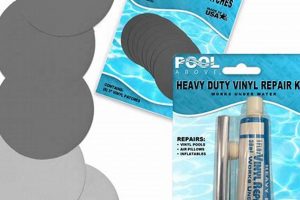
A repair solution designed for inflatable sleeping surfaces, commonly used for camping or temporary bedding, addresses punctures and leaks. This method typically involves applying an adhesive material, often a specialized vinyl or rubber compound, to seal the damaged area, restoring the air-tight integrity of the mattress. For instance, a pinhole leak can render an air mattress unusable; a properly applied sealant, along with a compatible covering, can rectify this issue.
The availability of effective methods for mending these inflatable structures offers several advantages. Primarily, it extends the lifespan of the product, reducing the need for frequent replacements and minimizing waste. Historically, these repair techniques have evolved alongside the materials used in constructing inflatable mattresses, from simple adhesive applications to more sophisticated bonding agents and reinforcement materials. The ability to mend punctures also provides economic benefits, saving consumers the cost of purchasing new mattresses when minor damage occurs.
Consequently, understanding the types of available repair kits, the proper techniques for application, and preventative measures to avoid damage are crucial for maintaining air mattresses in optimal condition. The following sections will delve into specific types of mending solutions, step-by-step application guides, and strategies for prolonging the useful life of these inflatable beds.
Guidance on Air Mattress Mending
The following provides practical advice to ensure effective and durable repairs to inflatable sleeping surfaces.
Tip 1: Surface Preparation is Paramount. Before applying any sealant, the area surrounding the puncture must be thoroughly cleaned and dried. Residue or moisture can compromise the adhesive bond, leading to premature failure. Use isopropyl alcohol for cleaning and allow ample time for complete evaporation.
Tip 2: Select the Appropriate Adhesive. Different materials require specific adhesives. Vinyl mattresses necessitate vinyl-compatible cements, while rubberized surfaces may demand rubber-specific bonding agents. Consult product specifications to ensure compatibility and optimal adhesion.
Tip 3: Apply Sealant Sparingly and Evenly. An excessive amount of adhesive does not necessarily result in a stronger bond; it can, in fact, weaken it. Apply a thin, uniform layer to both the mattress surface and the surface of the mending material.
Tip 4: Utilize a Reinforcement Layer. For larger punctures or tears, consider incorporating a reinforcing fabric patch underneath the primary sealing material. This additional layer provides structural support and prevents the damage from propagating further.
Tip 5: Allow Adequate Curing Time. Adhesives require specific curing times to achieve maximum bond strength. Adhere strictly to the manufacturer’s recommended curing duration before inflating the mattress. Premature inflation can disrupt the bond and necessitate repeat repairs.
Tip 6: Test the Repair Thoroughly. After the curing period, partially inflate the mattress and visually inspect the area for any signs of leaks or separation. Fully inflate the mattress only after confirming the integrity of the repair.
Tip 7: Store Mattresses Properly. When not in use, deflate the mattress completely, fold it carefully, and store it in a cool, dry location away from direct sunlight. This minimizes stress on the material and reduces the likelihood of future punctures.
Adhering to these recommendations will enhance the longevity and reliability of mended air mattresses, reducing the need for replacements and ensuring consistent performance.
The subsequent section will discuss preventative strategies to minimize the occurrence of punctures and extend the overall lifespan of inflatable sleeping surfaces.
1. Surface Preparation Protocols

Surface preparation protocols are fundamental to the successful repair of inflatable sleeping surfaces. The adherence to these protocols directly influences the bond strength and longevity of any mend applied to an air mattress. Proper preparation ensures the adhesive can effectively grip the mattress material, creating a secure and durable seal.
- Cleaning the Affected Area
This facet involves the removal of any dirt, oil, or debris from the immediate vicinity of the puncture. Contaminants can interfere with adhesive bonding, weakening the mend. Isopropyl alcohol is commonly used for its degreasing and drying properties. Neglecting this step can lead to premature mend failure, necessitating repeated repairs.
- Abrasive Treatment
Slightly roughening the surface with fine-grit sandpaper or an abrasive pad enhances adhesion by increasing the surface area available for bonding. This process creates microscopic indentations that allow the adhesive to mechanically interlock with the mattress material. Excessive abrasion, however, can damage the mattress further.
- Drying the Surface
Moisture impedes adhesive bonding. Ensuring the area is completely dry before applying any mending material is critical. Allowing sufficient drying time after cleaning is essential. Forced air drying can expedite the process, but care must be taken to avoid overheating the material.
- Masking and Isolation
In certain cases, masking the surrounding area can prevent unintended adhesive application. This technique maintains a clean and professional finish, particularly when dealing with large or irregularly shaped punctures. Masking also protects undamaged areas of the mattress from potential solvent exposure.
These facets of surface preparation are inextricably linked to the overall effectiveness of solutions for inflatable beds. Without meticulous attention to these details, the lifespan of the mended area will be significantly reduced, ultimately impacting the utility and longevity of the air mattress.
2. Adhesive Compatibility Factors

The selection of an appropriate adhesive is critical for the successful and durable mending of inflatable sleeping surfaces. The interaction between the adhesive and the mattress material at a molecular level dictates the strength and longevity of the mend. Incompatible adhesives can lead to premature failure, rendering the repair ineffective.
- Material Composition of the Mattress
Air mattresses are commonly constructed from polyvinyl chloride (PVC), thermoplastic polyurethane (TPU), or rubberized fabrics. Each material possesses distinct chemical properties and surface energies, influencing adhesive bonding. For instance, an adhesive formulated for PVC may not effectively bond to TPU. Selecting an adhesive specifically designed for the mattress material is paramount for ach
ieving a robust and lasting mend. - Adhesive Chemistry and Formulation
Adhesives vary in their chemical composition, ranging from solvent-based cements to water-based emulsions and cyanoacrylates. Each adhesive type exhibits unique adhesion mechanisms and performance characteristics. Solvent-based cements often provide superior bond strength on PVC, while cyanoacrylates may offer faster curing times. The adhesive’s formulation must be compatible with the mattress material to prevent degradation or weakening of either component.
- Environmental Resistance
Repaired air mattresses may be subjected to varying environmental conditions, including temperature fluctuations, humidity, and exposure to sunlight. Adhesives must exhibit sufficient resistance to these factors to maintain bond integrity over time. For instance, an adhesive prone to UV degradation may become brittle and fail when exposed to sunlight, while an adhesive susceptible to hydrolysis may weaken in humid environments. Selecting an adhesive with appropriate environmental resistance is crucial for long-term mend durability.
- Flexibility and Elasticity
Air mattresses undergo inflation and deflation cycles, subjecting mends to stress and strain. The adhesive must possess sufficient flexibility and elasticity to accommodate these deformations without cracking or delaminating. A rigid adhesive may create a stress concentration at the mend interface, leading to premature failure. An adhesive with adequate flexibility will distribute stress more evenly, enhancing the mend’s resistance to fatigue.
The interplay of these factors determines the efficacy of any solution. The correct choice of adhesive is as critical as the proper application technique, ensuring both the immediate seal and the long-term integrity of the mend under repeated use and varying environmental conditions.
3. Application Technique Accuracy

Application technique accuracy is a cornerstone of successful inflatable mattress repair. The precision with which the mending material is applied directly influences the quality of the seal, the durability of the repair, and the overall lifespan of the patched surface. Any deviation from established best practices can compromise the mend, leading to air leakage and the need for repeated interventions.
- Precise Alignment of the Patch
Accurate placement of the mending material over the damaged area is essential. Misalignment can leave portions of the puncture exposed or create stress points along the edges of the patch, increasing the risk of delamination. The patch should extend sufficiently beyond the damaged area to ensure a complete seal. For example, a circular mend should be centered directly over a pinhole, with an equal margin of material extending beyond the hole’s perimeter. Improper alignment can lead to immediate or gradual air loss.
- Uniform Pressure Application
Applying consistent pressure across the entire surface of the mending material ensures optimal contact between the adhesive and the mattress material. Uneven pressure can result in air pockets or weak spots in the bond. Using a roller or a smooth, hard object to apply pressure evenly distributes the adhesive and maximizes the contact area. Inadequate pressure can lead to premature patch failure, particularly in areas subjected to high stress during inflation and use.
- Bubble Elimination During Application
The presence of air bubbles between the mending material and the mattress surface can compromise the integrity of the seal. Trapped air disrupts the adhesive bond, creating pathways for air leakage. Employing a rolling motion or a squeegee-like tool during application helps to expel air bubbles and ensure intimate contact between the materials. Failure to eliminate bubbles can significantly reduce the lifespan of the mend and necessitate further repairs.
- Cleanliness During the Process
Maintaining a clean work environment and handling the mending materials with clean hands or tools prevents the introduction of contaminants that could weaken the adhesive bond. Grease, dirt, or other debris can interfere with the adhesion process, resulting in a compromised seal. Disposable gloves and a clean work surface are recommended to minimize contamination. Introducing contaminants during application can lead to mend failure and the need for complete replacement of the air mattress.
These elements of application technique accuracy are inextricably linked to the long-term effectiveness of patching. Each facet contributes to a secure, durable, and leak-free repair, maximizing the utility and lifespan of the patched surface. Adherence to these principles minimizes the risk of recurring issues and ensures a reliable solution for damaged inflatable sleeping surfaces.
4. Material Reinforcement Strategies

Material reinforcement strategies, when considered within the context of air mattress patching, directly influence the longevity and structural integrity of the repair. The objective is to augment the strength of the bond between the mending material and the air mattress itself, particularly when addressing larger punctures or tears. These strategies counteract the inherent vulnerability of the mended area to stress and strain during inflation and deflation cycles, extending the usable life of the air mattress. A primary cause for patch failure is inadequate reinforcement, leading to stress concentrations at the patch’s edges and subsequent delamination. An effective reinforcement strategy transforms a simple patch into a structurally sound component, capable of withstanding repeated use.
One common example is the use of fabric backing materials, such as canvas or nylon, laminated or adhered to the underside of the patch. This fabric layer provides increased tensile strength and resistance to tearing, particularly in cases where the original puncture was significant. Another approach involves applying multiple layers of the patching material, creating a composite structure that distributes stress more evenly. For example, when repairing a large tear in a PVC air mattress, a vinyl patch reinforced with a layer of nylon fabric adhered with a flexible adhesive can provide a significantly more durable repair than a single layer of vinyl alone. Further, applying a sealant along the edges of the reinforced patch can prevent moisture ingress and potential adhesive degradation.
In summary, material reinforcement strategies are a critical component of effective air mattress mending. By increasing the strength and durability of the patch, they mitigate the risk of future failures and extend the usable lifespan of the mattress. Understanding the principles of material reinforcement and their practical application is essential for anyone seeking to perform reliable and long-lasting repairs on inflatable sleeping surfaces. While surface preparation and adhesive selection are important, reinforcement is often the deciding factor in the success of a patch, especially when addressing substantial damage.
5. Curing Duration Adherence

Adherence to specified curing durations is a critical factor in the successful application of mends to inflatable sleeping surfaces. The curing process allows the adhesive to fully bond with both the mattress material and the patching material, establishing a secure and durable seal. Deviations from recommended curing times, either through premature use or prolonged delay, can compromise the integrity of the mend and lead to air leakage. Consequently, understanding and strictly adhering to these guidelines is essential for ensuring the effectiveness and longevity of any air mattress solution.
- Adhesive Polymerization Process
The majority of adhesives used in repairing air mattresses undergo a polymerization process during curing. This process involves the formation of chemical bonds between the adhesive molecules and the surfaces to which it is applied. Insufficient curing time prevents complete polymerization, resulting in a weaker bond that is more susceptible to failure. For example, if a solvent-based adhesive is not allowed sufficient time to evaporate, the remaining solvent can plasticize the adhesive, reducing its strength and durability. Adherence to specified curing times allows for optimal cross-linking and bond formation.
- Bond Strength Development
The bond strength between the mending material and the air mattress increases over time during the curing process. The adhesive’s ability to resist tensile and shear forces is directly proportional to the degree of curing. Premature inflation or use of the air mattress before full curing can disrupt the developing bond, leading to delamination or air leakage. In a practical scenario, inflating an air mattress just hours after applying a patch, instead of waiting the recommended 24-48 hours, may cause the patch to peel away from the mattress due to insufficient bond strength.
- Environmental Factor Influence
Curing times are often influenced by environmental factors such as temperature and humidity. Higher temperatures generally accelerate the curing process, while lower temperatures and high humidity can slow it down. Manufacturers’ recommendations typically assume standard conditions, and adjustments may be necessary based on the specific environment. For example, if repairing an air mattress in a cold, damp environment, extending the curing time beyond the manufacturer’s suggestion may be necessary to ensure complete bonding.
- Testing Integrity Post-Cure
Verifying the integrity of the repair after the specified curing duration is a crucial step. This involves carefully inspecting the mended area for any signs of air leakage or delamination. Applying gentle pressure to the patch can help identify any weak spots or areas where the bond is compromised. Inflation to a partial capacity before full inflation can also serve as a test. Addressing any issues detected after the curing period is complete is more effective than attempting to repair a failing patch after the mattress has been fully inflated and subjected to stress.
In conclusion, adhering to specified curing durations is non-negotiable for the long-term success of air mattress. This step allows the adhesive to fully realize its bonding potential, resisting the forces that would otherwise compromise the repair. Failing to respect these durations is likely to result in premature patch failure and render the mending effort ineffective, highlighting the importance of patience and precision in the air mattress mending process. Environmental adjustments, post-cure testing, and understanding polymer science all play key roles to fully patching air mattress.
Frequently Asked Questions
The following addresses common inquiries regarding inflatable sleeping surface repair, offering guidance on best practices and troubleshooting common issues.
Question 1: What constitutes an irreparable air mattress puncture?
While most punctures can be mended, extensive damage, such as large tears exceeding several inches or multiple closely spaced punctures, may compromise the structural integrity of the mattress to the point where repair is impractical. The cost of materials and labor may outweigh the cost of a replacement in such cases. In addition, damage to internal baffles or seams is often beyond practical repair.
Question 2: Can any adhesive be used to patch an air mattress?
No. The adhesive must be compatible with the material of the air mattress, typically PVC, TPU, or rubberized fabric. Using an incompatible adhesive will result in a weak or non-existent bond, leading to air leakage and patch failure. Adhesives specifically designed for vinyl or rubber are recommended.
Question 3: How long should an air mattress patch last?
The lifespan of a properly applied air mattress patch depends on several factors, including the size and location of the puncture, the quality of the adhesive and mending material, and the care taken during application. A well-executed mend can last for several years under normal use conditions. However, patches in high-stress areas may require periodic inspection and potential reapplication.
Question 4: Is it necessary to deflate the air mattress completely before applying a patch?
Yes. Complete deflation is essential for ensuring proper adhesion and preventing air pressure from interfering with the bonding process. Deflating the mattress allows the patch to be applied to a flat, stable surface, maximizing contact between the adhesive and the mattress material.
Question 5: What is the best method for cleaning an air mattress before applying a patch?
The area surrounding the puncture should be cleaned with isopropyl alcohol to remove any dirt, oil, or debris that could interfere with adhesion. A clean, lint-free cloth should be used to apply the alcohol, and the surface should be allowed to dry completely before applying the patch.
Question 6: How can future punctures in air mattresses be prevented?
Preventative measures include using the air mattress on a smooth, debris-free surface, avoiding over-inflation, and storing the mattress in a protective bag when not in use. Additionally, keeping sharp objects away from the inflated mattress and regularly inspecting it for signs of wear or damage can help prevent punctures.
These answers provide a foundation for understanding best practices in inflatable surface mending. Consistent application of these principles enhances the likelihood of successful, long-lasting repairs.
The subsequent section will address the broader implications of inflatable bedding maintenance and the environmental benefits of repair over replacement.
Conclusion
This exploration has detailed the critical aspects of air mattress patching, emphasizing surface preparation, adhesive compatibility, application technique, material reinforcement, and curing duration. Each element directly impacts the efficacy and longevity of the resulting solution, influencing the service life of the inflatable bedding and reducing waste.
Effective utilization of these techniques provides a sustainable alternative to frequent replacement, mitigating environmental impact and offering economic advantages. Continued adherence to these principles will ensure prolonged utility of air mattresses, fostering responsible consumption and resource management. Investing in appropriate repair knowledge and materials represents a commitment to both product longevity and environmental stewardship.