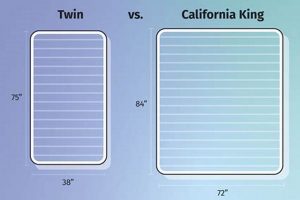
The variance in dimensions between queen and king mattresses represents a significant factor in selecting the appropriate bedding for individual needs and spatial constraints. A queen mattress typically measures 60 inches in width and 80 inches in length, while a standard king mattress extends to 76 inches in width and maintains the same 80-inch length. This 16-inch difference in width offers considerable additional space for sleepers.
Selecting an appropriately sized mattress directly impacts sleep quality and overall comfort. Adequate space allows for undisturbed rest, particularly beneficial for couples. Historically, mattress sizes have evolved to accommodate changing lifestyle preferences and increasing expectations for personal space within the sleeping environment. The king size, in particular, gained popularity as a means of providing couples with more individual sleeping area.
The subsequent discussion will delve into the specific applications and considerations for each size, analyzing aspects such as room size compatibility, suitability for co-sleeping with children or pets, and the corresponding requirements for bedding and frames. Detailed dimensional comparisons will further highlight the nuances between these popular mattress options.
Selecting Between Queen and King Mattress Sizes
Choosing the appropriate mattress size requires careful consideration of several factors, ensuring optimal comfort and functionality within the bedroom space. The following tips provide guidance for navigating the selection process.
Tip 1: Assess Room Dimensions. Prior to purchasing, meticulously measure the intended bedroom. The mattress should allow for ample movement around the bed and accommodate other furniture. A king mattress generally requires a larger room, typically at least 12 feet by 12 feet, while a queen can fit comfortably in a smaller space.
Tip 2: Evaluate Sleep Partner Needs. If sharing the bed, consider the sleeping habits of both individuals. A king size provides significantly more personal space, minimizing disturbances caused by movement or varying sleep schedules. If one partner is a restless sleeper, the extra width can prove invaluable.
Tip 3: Determine Budgetary Constraints. King-size mattresses typically command a higher price point than queen-size options. This extends beyond the mattress itself to encompass bedding, frames, and potentially larger bedroom furniture to complement the larger bed.
Tip 4: Account for Co-Sleeping Arrangements. Families who frequently co-sleep with children or pets should strongly consider the king size. The increased surface area provides a more comfortable and less cramped environment for all occupants.
Tip 5: Consider Future Mobility. Larger mattresses, particularly king sizes, can present challenges during relocation. Assess the ease of maneuvering the mattress through doorways, hallways, and stairwells in both the current and potential future residences.
Tip 6: Evaluate Existing Bedding and Frame. Before committing to a new mattress size, confirm the compatibility with existing bedding and bed frame. Purchasing a king mattress necessitates new sheets, blankets, and potentially a new frame if the current one is designed for a queen.
By carefully evaluating room size, sleeping partner needs, budgetary constraints, and future considerations, an informed decision can be made, leading to improved sleep quality and overall satisfaction. The ideal selection harmonizes with individual circumstances and priorities.
The subsequent section will explore specific scenarios and use cases to further illustrate the practical implications of each mattress size.
1. Width Dimension

The “Width Dimension” is a primary component contributing to the overall dimensional disparity between queen and king mattresses. This 16-inch difference in width, with queen mattresses typically measuring 60 inches and king mattresses 76 inches, significantly impacts the perceived and actual sleeping space available to occupants. This differential is not merely a numerical value; it directly influences comfort levels, particularly for couples or individuals who value ample personal space during sleep. For example, couples who experience restless sleep or have differing sleep schedules frequently benefit from the increased width of a king mattress, as it mitigates the transfer of movement and minimizes sleep disruption.
The influence of the width dimension extends beyond individual sleeping comfort to encompass practical considerations regarding room size and furniture arrangement. A king mattress demands a larger room to ensure adequate circulation and prevent the space from feeling cramped. Conversely, a queen mattress offers greater flexibility in smaller bedrooms, allowing for more adaptable furniture placement. The choice between queen and king sizes, therefore, becomes a compromise between prioritizing sleeping space and maintaining an aesthetically pleasing and functional bedroom environment.
In summary, the width dimension serves as a crucial differentiating factor, dictating not only sleeping comfort but also the spatial compatibility and overall cost associated with each mattress size. Its influence necessitates careful evaluation of individual needs and environmental constraints to ensure an informed and ultimately satisfying mattress selection. The understanding of the “Width Dimension” impact is essential for an informed decision when navigating the “difference between queen and king mattress size”.
2. Surface Area

The surface area differential constitutes a primary aspect of the variance between queen and king mattress sizes. This quantifiable measurement, calculated by multiplying the mattress’s width and length, directly influences sleeping space availability and comfort. The king mattress offers a significantly larger surface area compared to a queen, translating into increased personal space for each sleeper. This becomes particularly relevant for couples, as the additional area mitigates the impact of movement during sleep, potentially reducing disturbances and improving overall rest quality. The larger surface accommodates a wider range of sleeping positions and reduces the likelihood of accidental contact with a sleep partner.
A practical example illustrates this point: a couple accustomed to a queen mattress might experience restricted movement and increased sleep disruptions due to limited individual space. Transitioning to a king-sized mattress with its expanded surface area could alleviate these issues, providing each individual with ample room to adjust positions and sleep without encroaching on the other’s space. This advantage extends beyond couples to individuals who prefer a larger sleeping area for enhanced comfort. Furthermore, families who co-sleep with children or pets often fin
d the extra surface area of a king mattress essential for maintaining a comfortable and safe sleeping environment for all involved.
In conclusion, the surface area is a crucial element of the overall distinction between queen and king mattresses. It directly impacts sleeping comfort, reduces sleep disturbances, and accommodates diverse sleeping arrangements. While the larger surface area of a king mattress presents advantages in terms of space and comfort, it necessitates considering room size and budgetary implications. Understanding the practical significance of surface area is thus paramount when selecting a mattress that aligns with individual needs and lifestyle considerations, specifically addressing the “difference between queen and king mattress size.”
3. Spatial Requirements

The spatial requirements of queen and king mattresses represent a critical distinction when evaluating their suitability for a given bedroom. The dimensional variation significantly impacts room layout and functionality. A king-size mattress, owing to its greater width and corresponding larger footprint, necessitates a more expansive room to ensure comfortable movement and maintain visual balance. Cramped spaces can negatively impact the perceived comfort and overall aesthetic of the bedroom environment. Consequently, the physical dimensions of the room directly influence the appropriate mattress size selection. For example, a master bedroom measuring 10 feet by 12 feet may comfortably accommodate a queen mattress, leaving sufficient space for nightstands and walking areas. Conversely, attempting to fit a king mattress into this same room could result in a congested and impractical arrangement.
Beyond the mattress itself, spatial considerations extend to associated furniture and accessories. A king-size bed frame typically occupies more floor space than a queen frame, and larger nightstands may be required to maintain proportional balance. The placement of dressers, chairs, and other bedroom furnishings must be carefully planned to avoid obstructing pathways and creating a sense of confinement. Furthermore, individuals should account for the swing radius of doors and drawers when arranging furniture around a larger bed. Careful consideration of these factors ensures the bedroom remains a functional and aesthetically pleasing space.
In summary, understanding the spatial implications of “difference between queen and king mattress size” is paramount for effective bedroom design. The mattress size must harmonize with the room’s dimensions to facilitate comfortable movement, accommodate essential furniture, and maintain visual appeal. Failure to address spatial requirements adequately can result in a cramped, dysfunctional, and visually unappealing bedroom. The assessment of room size, furniture arrangement, and accessory placement is a prerequisite for making an informed mattress selection, ultimately optimizing the overall comfort and functionality of the sleeping environment.
4. Bedding Costs
The cost associated with bedding constitutes a significant factor when evaluating the practical implications of the dimensional variance between queen and king mattresses. The increased surface area of a king mattress directly translates into higher expenses for sheets, blankets, comforters, and bed frames. This financial aspect warrants careful consideration during the mattress selection process.
- Initial Purchase Price
The initial purchase price for bedding designed for a king-size mattress is generally higher than that for queen-size bedding. Larger fabric requirements and specialized manufacturing processes contribute to the elevated cost. Consumers should anticipate a noticeable price difference when comparing similar quality bedding sets for the two sizes.
- Replacement Frequency
While the frequency of bedding replacement remains consistent regardless of mattress size, the replacement cost for king-size sets remains higher. Over the lifespan of a mattress, the cumulative expense of replacing worn or outdated bedding can become substantial. Budgetary planning should account for these recurring expenditures.
- Specialty Bedding
Specialty bedding, such as weighted blankets or high thread count sheets, often exhibits a more pronounced price differential between queen and king sizes. The unique manufacturing requirements and premium materials associated with these items amplify the cost difference attributable to size.
- Customization Options
Customized bedding solutions, including tailored sheets or duvet covers, typically incur significant surcharges for king-size dimensions. The complexity of adapting designs and patterns to accommodate the larger size increases manufacturing time and material usage, resulting in higher prices for custom orders.
In summary, the financial implications of bedding costs are directly linked to the dimensional characteristics of queen and king mattresses. Consumers must factor in the initial purchase price, replacement frequency, specialty bedding costs, and customization options when assessing the overall affordability of each mattress size. Careful evaluation of these factors ensures a financially responsible decision aligned with individual budgetary constraints and preferences. A comprehensive understanding of the “difference between queen and king mattress size” and its relationship to associated bedding expenses is essential for making an informed choice.
5. Partner Disturbance

Partner disturbance, defined as sleep disruption caused by the movements or habits of a bed partner, is directly influenced by the dimensional characteristics differentiating queen and king mattresses. The degree to which one partner’s sleep impacts another is inversely proportional to the available sleeping space.
- Motion Isolation
Motion isolation, the mattress’s ability to minimize the transfer of movement from one area to another, is a key factor mitigating partner disturbance. King mattresses, with their greater surface area, inherently offer superior motion isolation compared to queen mattresses. The increased width provides a greater distance between sleepers, reducing the likelihood that movements such as tossing and turning will disturb the other individual. For example, a couple where one partner is a restless sleeper often finds that transitioning to a king mattress significantly reduces the frequency of sleep interruptions.
- Edge Support
Edge support refers to the stability and firmness of the mattress edges. Strong edge support maximizes the usable sleeping surface and prevents sleepers from feeling like they might roll off the bed. King mattresses generally exhibit superior edge support simply due to their greater width and often more robust construction. Improved edge support contributes to reduced partner disturbance by minimizing the impact of movement near the edge of the mattress, preventing it from transferring to the center sleeping area.
- Individual Sleeping Space
The available individual sleeping space is a straightforward determinant of partner dist
urbance. A king mattress provides significantly more individual space than a queen, allowing each sleeper more room to move and adjust positions without encroaching on the other’s territory. This is particularly relevant for couples with differing sleep schedules or preferences. For instance, if one partner tends to spread out during sleep, the increased individual space offered by a king mattress can prevent the other partner from feeling cramped or disturbed. - Temperature Regulation
While not directly related to mattress size, temperature regulation can exacerbate partner disturbance. If one partner sleeps hot, the confined space of a queen mattress can lead to increased heat transfer, potentially disrupting the sleep of the cooler sleeper. The greater surface area of a king mattress provides more space for heat dissipation, potentially reducing this form of disturbance. Additionally, the increased space allows for the use of separate blankets with varying levels of insulation, accommodating individual temperature preferences.
These aspects clearly indicate that the larger dimensions of a king mattress can mitigate partner disturbance, leading to improved sleep quality for both individuals. The decision between queen and king should therefore incorporate an assessment of potential partner disturbance and a consideration of how the dimensional “difference between queen and king mattress size” impacts that variable.
Frequently Asked Questions Regarding Queen and King Mattress Size Discrepancies
The following section addresses common inquiries and concerns pertaining to the dimensional variances between queen and king-size mattresses. The information provided aims to clarify misconceptions and facilitate informed decision-making during the mattress selection process.
Question 1: What precisely constitutes the dimensional variance between a queen and king mattress?
A queen mattress typically measures 60 inches in width and 80 inches in length, while a standard king mattress measures 76 inches in width and 80 inches in length. The primary dimensional difference lies in the 16-inch disparity in width. The length remains consistent between the two sizes.
Question 2: How does the dimensional difference affect the suitability of each mattress size for a specific bedroom?
King mattresses generally require larger bedrooms to ensure comfortable movement and maintain visual balance. Queen mattresses offer greater versatility and can be accommodated in smaller spaces without creating a cramped environment. Room dimensions should be carefully measured prior to selecting a mattress size.
Question 3: Does the dimensional disparity between queen and king mattresses influence the level of partner disturbance during sleep?
Yes, the larger surface area of a king mattress provides increased individual sleeping space, thereby mitigating partner disturbance caused by movements or varying sleep schedules. The expanded area reduces the likelihood of contact and minimizes the transfer of motion.
Question 4: Are bedding costs impacted by the choice between a queen and king mattress?
Yes, the increased surface area of a king mattress translates into higher costs for sheets, blankets, comforters, and bed frames. Larger fabric requirements and specialized manufacturing processes contribute to the elevated cost of king-size bedding.
Question 5: Is the weight of a king mattress significantly greater than that of a queen mattress?
Generally, king mattresses are heavier than queen mattresses due to their increased size and greater material usage. The precise weight will vary depending on the mattress type and construction, but a king mattress can be expected to weigh considerably more than a queen.
Question 6: Does the increased size of a king mattress present challenges during relocation or transport?
Yes, king mattresses can be more difficult to maneuver through doorways, hallways, and stairwells due to their larger dimensions. Individuals should assess potential mobility challenges before opting for a king size, particularly if relocation or transport is anticipated in the future.
In summary, the dimensional “difference between queen and king mattress size” presents significant implications for room suitability, partner disturbance, bedding costs, mattress weight, and mobility during relocation. Careful consideration of these factors facilitates informed decision-making and ensures the selection of a mattress that aligns with individual needs and preferences.
The subsequent section will provide concluding remarks and summarize the key considerations discussed throughout this article.
Difference Between Queen and King Mattress Size
This exploration has delineated the significant dimensional differences between queen and king mattresses, emphasizing the practical implications of these disparities. Key areas of divergence include spatial requirements, partner disturbance, and bedding costs. The increased width and surface area of a king mattress necessitate larger bedrooms and often higher expenditures for bedding, while potentially mitigating sleep disruptions caused by a partner’s movements. The selection process should involve a thorough assessment of individual needs and environmental constraints to optimize sleep quality and overall satisfaction.
Ultimately, the choice between a queen and king mattress represents a personal decision predicated on a careful evaluation of space availability, budgetary limitations, and sleep-related priorities. Informed deliberation ensures a sleeping environment that promotes restful sleep and enhances overall well-being. Consumers should prioritize these considerations to maximize their investment and optimize their sleep experience.
![Ultimate Tempur-Pedic King Size Mattress [Guide & Review] | Organic & Natural Mattress Buyer’s Guide: Non-Toxic Sleep Solutions](https://mattressworldpa.com/wp-content/uploads/2025/07/th-8395-300x200.jpg "Ultimate Tempur-Pedic King Size Mattress [Guide & Review] Organic & Natural Mattress Buyer’s Guide: Non-Toxic Sleep Solutions")