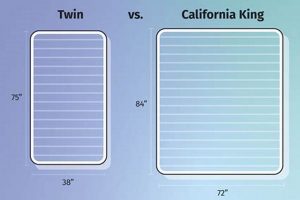
The process of moving a large bedding item, specifically one that measures approximately 76 inches wide by 80 inches long, presents unique challenges. These challenges stem from its substantial size, weight, and relative lack of rigidity. Successfully relocating such an item requires careful planning and execution to prevent damage to the mattress itself, surrounding property, and potential injury to those involved in the move.
Proper handling of such a large item is crucial for several reasons. Primarily, it protects the substantial investment the owner has made in their sleep comfort. Furthermore, it safeguards the physical well-being of those who undertake the task. A damaged mattress can become unusable, necessitating replacement costs. Improper lifting techniques during transport can result in back injuries or other musculoskeletal issues.
Therefore, a detailed examination of the necessary steps, required equipment, and optimal strategies for securely relocating a large mattress is essential. This will encompass methods for preparation, protection, lifting, carrying, securing, and unloading the item at its destination, ensuring a safe and efficient transfer.
Essential Strategies for Relocating a Large Mattress
The successful relocation of a large mattress hinges on meticulous planning and adherence to specific techniques. This section outlines crucial steps to ensure its safe and efficient transport.
Tip 1: Acquire a Mattress Bag: Enclose the mattress in a durable, purpose-built bag. This shields it from dirt, moisture, and potential tears during handling and transit. Opt for a heavy-duty plastic or reinforced material.
Tip 2: Secure Adequate Assistance: Due to the size and weight, at least two individuals are recommended for lifting and maneuvering. Coordinate lifting techniques to ensure even weight distribution and minimize strain.
Tip 3: Utilize Moving Straps or Dollies: Employing straps or a dolly significantly reduces the physical burden. Straps provide a secure grip and facilitate controlled movement, while a dolly allows for rolling the mattress over level surfaces.
Tip 4: Clear the Pathway: Before initiating movement, thoroughly clear all pathways of obstructions, including furniture, boxes, and potential tripping hazards. Ensure adequate lighting for visibility.
Tip 5: Employ Proper Lifting Techniques: Bend at the knees, keeping the back straight, when lifting the mattress. Maintain a firm grip and avoid twisting motions to prevent back injuries.
Tip 6: Secure the Mattress in the Vehicle: When transporting in a vehicle, secure the mattress to prevent shifting during transit. Straps or ropes should be used to firmly attach it to the vehicle’s interior or roof rack, if applicable.
Tip 7: Plan the Unloading Process: Before arrival, plan the unloading process at the destination. Identify the designated room and ensure a clear pathway for seamless entry.
Adhering to these strategies minimizes the risk of damage and injury, ensuring a smoother and more efficient relocation process. Proper preparation and execution are paramount.
The following sections will address alternative transport solutions and professional moving services, offering comprehensive guidance for various circumstances.
1. Measure doorway clearances

The act of measuring doorway clearances is intrinsically linked to the successful execution of transporting large bedding. The dimensions of a king-size mattress often exceed standard doorway widths, necessitating pre-emptive assessment. Failure to measure clearances can result in the mattress becoming lodged in a doorway, potentially causing damage to the mattress itself, the doorframe, or surrounding walls. This situation introduces delays, requires additional effort, and may even necessitate professional intervention to resolve. A real-world example involves a family attempting to move a king-size mattress into a new home without measuring. The mattress became stuck, requiring disassembly of the bed frame and, ultimately, removal of the doorframe trim to accommodate its passage. This oversight added considerable time and expense to the moving process.
Accurate measurement provides critical information for devising a viable transport strategy. It dictates whether the mattress can be moved through the doorway in its original orientation or if alternative maneuvers are required. These maneuvers may include rotating the mattress on its side, flexing it slightly, or, in extreme cases, temporarily removing the door from its hinges. Furthermore, understanding the clearance allows for proactive planning of the optimal path, identifying and addressing potential obstructions or tight corners along the way. Consider a scenario where a homeowner pre-measures a narrow hallway, discovering insufficient clearance. This foresight allows them to consider alternative routes, such as using a window or balcony, and to prepare accordingly with appropriate equipment and personnel.
In summation, measuring doorway clearances is not merely a preliminary step, but a crucial component of planning and executing the transport of a large mattress. It informs decision-making, mitigates potential damage, prevents delays, and ultimately contributes to a more efficient and stress-free relocation process. Overlooking this step can transform a straightforward task into a challenging and potentially costly ordeal, highlighting its practical significance.
2. Secure Protective Mattress Bag

The utilization of a secure, protective mattress bag is integral to the successful execution of any strategy for safely transporting a large bedding item. This component acts as a primary defense against potential damage and contamination during the relocation process.
- Protection from Physical Damage
A durable mattress bag safeguards against tears, punctures, and abrasions that can occur during handling. For instance, dragging a bare mattress across a rough surface can easily result in rips, compromising its structural integrity and hygiene. The bag provides a protective barrier, mitigating these risks.
- Prevention of Staining and Soiling
During transport, a mattress is vulnerable to staining from dirt, dust, liquids, and other contaminants. A quality mattress bag creates a sealed environment, preventing these substances from penetrating the fabric and causing irreversible damage. Consider a scenario where a mattress is inadvertently exposed to rain during loading; the bag acts as a shield, preventing water damage and mold growth.
- Pest Control and Hygiene Maintenance
Mattresses can attract pests such as bed bugs and dust mites. A sealed mattress bag inhibits infestation by preventing pests fro
m entering or exiting the mattress. This is particularly important during transport in shared vehicles or storage facilities, where exposure to pests is elevated. - Enhanced Handling and Grip
Certain mattress bags feature handles or reinforced sections that improve grip and maneuverability. This facilitates easier lifting and carrying, reducing the risk of dropping the mattress and causing damage or injury. The bag provides a more secure and stable surface for handling, compared to a bare mattress.
In summary, a secure protective mattress bag is an indispensable tool when moving a large mattress. It offers comprehensive protection against physical damage, staining, pests, and facilitates safer handling. The investment in a high-quality bag is a prudent measure that preserves the condition and longevity of the mattress, ensuring a successful relocation.
3. Recruit adequate assistance

The act of securing sufficient personnel is a foundational element in successfully transporting a large bedding item. The inherent size and weight of a king-size mattress necessitate collaborative effort to mitigate risk and ensure a safe, efficient relocation. Insufficient assistance directly increases the potential for physical injury and damage to property.
- Mitigation of Physical Strain
A king-size mattress can weigh upwards of 100 pounds, placing significant strain on individuals attempting to lift and maneuver it alone. Recruiting adequate assistance distributes the weight load, reducing the risk of back injuries, muscle strains, and other musculoskeletal issues. For example, a two-person team can evenly distribute the load, enabling controlled lifting and minimizing the need for awkward or strenuous movements.
- Enhanced Maneuverability in Confined Spaces
Navigating a large mattress through narrow doorways, hallways, and stairwells requires careful coordination and control. Adequate assistance allows for precise maneuvering in tight spaces, preventing the mattress from bumping into walls or furniture. A three- or four-person team can strategically position themselves to guide the mattress, ensuring it clears obstacles safely.
- Prevention of Damage to the Mattress
Dropping or mishandling a mattress can cause significant damage to its internal structure and outer fabric. Recruiting adequate assistance ensures a secure grip and prevents accidental drops. With multiple individuals supporting the weight, the mattress is less likely to be subjected to undue stress or impact.
- Increased Efficiency and Reduced Time
Transporting a large mattress with insufficient assistance can be a time-consuming and arduous task. Adequate personnel streamline the process, enabling quicker and more efficient movement. A well-coordinated team can complete the task in a fraction of the time it would take a single individual, minimizing disruption and inconvenience.
The strategic recruitment of adequate assistance is not merely a suggestion, but a critical requirement for the safe and effective transport of a king-size mattress. Failure to do so significantly elevates the risk of injury, property damage, and overall inefficiency. By securing sufficient personnel, individuals can ensure a smoother, safer, and more successful relocation process. Consider the contrast between a single individual struggling to move a mattress and a coordinated team working in unison; the latter exemplifies the tangible benefits of adequate assistance.
4. Employ proper lifting technique

The application of correct lifting methods is inextricably linked to the safe and successful execution of a mattress relocation. The improper lifting of a king-size mattress, given its dimensions and weight, invariably leads to an increased risk of musculoskeletal injury. A real-world consequence of neglecting proper technique often manifests as lower back strain, a debilitating condition that can result in chronic pain and require medical intervention. Moreover, an individual struggling to lift a mattress without utilizing proper form is more prone to losing control of the object, leading to potential damage to the mattress itself or surrounding property.
Proper lifting entails maintaining a straight back, bending at the knees, and keeping the mattress close to the body to minimize leverage. This technique reduces stress on the spine and engages stronger leg muscles for lifting. For example, consider a scenario where two individuals lift a mattress, one bending at the waist while the other maintains a straight back and bent knees. The individual bending at the waist is significantly more likely to experience back strain due to the increased stress on the lumbar region. Furthermore, utilizing teamwork and communication, ensuring synchronized lifting, and taking frequent breaks are crucial elements of a safe and effective strategy.
In summation, the integration of appropriate lifting techniques is not merely an optional consideration, but an indispensable component of mattress relocation. Failure to prioritize proper form introduces significant risks to both the individuals involved and the mattress itself. Emphasizing ergonomic principles and safe lifting practices directly translates to a reduction in injuries and damages, contributing to a more efficient and secure relocation process. The practical significance of this understanding cannot be overstated, as it directly impacts the physical well-being of those undertaking the task.
5. Utilize moving straps/dolly

The strategic integration of moving straps and dollies represents a crucial element in the safe and efficient relocation of a large bedding item. These tools directly address the challenges posed by the item’s weight, size, and inherent unwieldiness, mitigating the risks associated with manual handling and ensuring a more controlled and secure transport process.
- Enhanced Weight Distribution and Leverage
Moving straps redistribute the weight of the mattress, enabling individuals to lift and carry it with improved leverage. By securing the straps around the mattress and distributing the load across the shoulders or forearms, the perceived weight is reduced, and the risk of strain injuries is minimized. For instance, a two-person team using moving straps can comfortably manage a mattress that would otherwise be exceedingly difficult to handle without assistance. This allows for better control and reduces the likelihood of dropping the mattress.
- Facilitation of Movement Over Level Surfaces
A furniture dolly provides a rolling platform for the mattress, simplifying its transport over level surfaces. This eliminates the need to carry the full weight of the mattress, reducing physical exertion and speeding up the relocation process. In scenarios where a mattress needs to be moved across a long hallway or through a spacious room, a dolly significantly reduces the effort required and minimizes the risk of damage to flooring.
- Improved Maneuverability in Confined Spacesong>
Moving straps and dollies, when used in conjunction, can enhance maneuverability in tight spaces. Straps allow for controlled lifting and tilting of the mattress, enabling it to be navigated through narrow doorways or around corners. A dolly facilitates smooth rotation and directional changes, allowing for precise placement of the mattress within a confined space. A team using both straps and a dolly can efficiently maneuver a mattress up a narrow staircase landing.
- Reduction of Risk to Property
The controlled movement facilitated by moving straps and dollies minimizes the risk of the mattress bumping into walls, furniture, or other objects, preventing damage to both the mattress and the surrounding environment. Secure straps prevent the mattress from swaying or slipping, while a dolly provides a stable base that reduces the likelihood of accidental collisions. This is particularly important in occupied residences or spaces with delicate or valuable items.
In conclusion, the utilization of moving straps and dollies offers a substantial advantage in the relocation of large mattresses. By improving weight distribution, facilitating movement, enhancing maneuverability, and reducing the risk of damage, these tools contribute significantly to a safer, more efficient, and less physically demanding transport process. The integration of these tools demonstrates a proactive approach to mitigating the inherent challenges associated with moving such a large and unwieldy object.
6. Secure during transportation
The phase of securing a king-size mattress during transportation is a critical determinant of a successful relocation, directly influencing the mattress’s condition upon arrival and the safety of both the item and those involved in the process. Inadequate securing measures can lead to damage, shifting within the transport vehicle, and potential road hazards. The following points delineate the multifaceted significance of proper securing techniques.
- Prevention of Shifting and Damage
An unsecured mattress within a moving vehicle is susceptible to shifting, sliding, and colliding with other objects. This movement can result in tears to the mattress fabric, compression of internal components, and structural damage. Securing the mattress with robust straps or ropes mitigates this risk by stabilizing its position, minimizing movement, and preventing contact with potentially damaging surfaces. For example, a sudden stop could cause an unsecured mattress to collide with the cab of a truck, resulting in significant damage.
- Mitigation of Road Hazards
An improperly secured mattress poses a serious safety risk to other motorists. If the mattress were to fall from the transport vehicle, it could create a significant road hazard, potentially leading to accidents and injuries. Securing the mattress with appropriate tie-downs ensures that it remains firmly attached to the vehicle, preventing any possibility of it becoming dislodged during transit. Consider the scenario where a mattress falls off a vehicle on a highway, creating an immediate and significant danger to surrounding traffic.
- Protection from Environmental Elements
During transportation, a mattress can be exposed to various environmental elements, including rain, wind, and debris. Inadequate securing can allow these elements to penetrate the protective covering and damage the mattress itself. Securing the mattress with weatherproof tarps or coverings, in addition to tie-downs, provides an added layer of protection against environmental damage. For instance, heavy rain could saturate an unprotected mattress, leading to mold and mildew growth.
- Adherence to Legal Requirements
Many jurisdictions have specific regulations regarding the securing of loads during transportation. Failure to comply with these regulations can result in fines, penalties, and potential liability in the event of an accident. Ensuring that the mattress is secured in accordance with all applicable laws and regulations is a crucial aspect of responsible transportation. Transporting an unsecured mattress on a public road could result in a citation and potential vehicle impoundment.
The principles of “how to transport king size mattress” necessitate a comprehensive approach that prioritizes safety, damage prevention, and legal compliance. The act of securing the mattress during transportation directly addresses these concerns, ensuring that the item arrives at its destination in optimal condition and without posing a risk to others. A failure to adequately secure the mattress represents a critical oversight that can have significant and far-reaching consequences.
7. Plan unloading destination

Prior to initiating the physical transport of a large mattress, meticulous planning of the unloading destination is crucial. This proactive step streamlines the final stages of the move, minimizing potential complications, delays, and risks of damage or injury. A well-defined unloading plan considers spatial constraints, pathway obstructions, and logistical considerations to ensure a seamless transition from the transport vehicle to the intended location within the residence or facility.
- Assessment of Access Points
Evaluating potential access points, such as doorways, hallways, and stairwells, is paramount. Measurements of these spaces must be taken to confirm that the mattress can be maneuvered without obstruction. For example, a narrow doorway may necessitate tilting or rotating the mattress, or even temporarily removing the door frame. Failure to assess access points can result in the mattress becoming lodged, leading to damage to the mattress or the property, and requiring unplanned problem-solving.
- Identification of Obstructions
Before unloading, a thorough assessment of the pathway from the access point to the final destination is essential to identify and remove any obstructions. Furniture, boxes, and other items must be cleared to create a clear and unimpeded route. Overlooking this step can lead to difficulties in maneuvering the mattress, increasing the risk of accidental collisions and property damage. For instance, a low-hanging light fixture or a strategically placed rug could impede the movement of the mattress.
- Coordination with Personnel
Effective communication and coordination with all personnel involved in the unloading process is vital. Clear instructions regarding the designated route, lifting techniques, and placement within the room must be conveyed to ensure a synchronized and efficient operation. A lack of coordination can result in confusion, miscommunication, and an increased risk of injury or damage. For instance, assigning specific roles, such as guiding the mattress or opening doors, can streamline the process.
- Preparation of the Final Location
Prior to bringing the mattress into the room, the final location should be prepared by clearing any remaining obstacles and ensuring the bed frame is ready to receive the mattress. This proactive step prevents delays and minimizes the need for further maneuvering within the room. For example, removing bedding from the bed frame and ensuring it is properly assembled can facilitate the seamless placement of the
mattress.
The planning of the unloading destination is not merely a logistical detail, but an integral component of a comprehensive “how to transport king size mattress” strategy. By meticulously assessing access points, identifying obstructions, coordinating with personnel, and preparing the final location, individuals can significantly reduce the risk of complications and ensure a smooth and efficient relocation process. Neglecting this critical step can introduce unnecessary challenges and potential setbacks.
Frequently Asked Questions
The following section addresses common inquiries regarding the complexities and considerations involved in relocating a large bedding item. It aims to provide clear and concise information to facilitate a safe and efficient transport process.
Question 1: Is professional assistance always necessary when transporting a king size mattress?
Professional assistance is not invariably required; however, it is strongly recommended, particularly for individuals lacking experience in moving large items or those with physical limitations. Professional movers possess the necessary equipment and expertise to handle the mattress safely and efficiently, minimizing the risk of damage or injury.
Question 2: What is the recommended type of mattress bag for protecting a king size mattress during transport?
A heavy-duty plastic or reinforced polyethylene mattress bag specifically designed for king size mattresses is recommended. This type of bag offers superior protection against tears, punctures, moisture, and pests, ensuring the mattress remains clean and undamaged during transit.
Question 3: How can one determine the optimal method for securing a king size mattress to a vehicle?
The optimal method depends on the type of vehicle being used. In general, ratcheting straps or heavy-duty ropes are recommended to secure the mattress to the vehicle’s roof rack or within the cargo area. The straps should be tightened securely to prevent shifting during transit, and the mattress should be protected from the elements with a waterproof tarp if necessary.
Question 4: What are the potential consequences of improper lifting techniques when handling a king size mattress?
Improper lifting techniques can lead to a range of musculoskeletal injuries, including back strains, muscle sprains, and herniated discs. Maintaining a straight back, bending at the knees, and lifting with the legs are essential for minimizing the risk of injury.
Question 5: Is it permissible to transport a king size mattress on the roof of a car?
Transporting a king size mattress on the roof of a car is generally discouraged due to safety concerns. The large surface area of the mattress can create significant wind resistance, potentially leading to instability and an increased risk of the mattress becoming dislodged. If transporting on the roof is unavoidable, it is imperative to secure the mattress with multiple strong tie-downs and to drive at a reduced speed.
Question 6: What are the alternatives to self-transport for a king size mattress?
Alternatives to self-transport include hiring a professional moving company, renting a moving truck with a lift gate, or utilizing a specialized mattress delivery service. These options offer varying levels of convenience and cost, allowing individuals to choose the method that best suits their needs and budget.
In summary, careful planning, the utilization of appropriate equipment, and adherence to safe handling practices are paramount when transporting a large bedding item. Consulting with professionals and thoroughly researching available options can further ensure a successful and stress-free relocation process.
The following sections will discuss alternative methods to relocate mattress and other information resources.
Concluding Considerations
The preceding discussion has elucidated the multifaceted aspects associated with relocating a king size mattress. Key considerations encompass meticulous planning, the acquisition of appropriate protective materials and equipment, adherence to proper lifting techniques, and the implementation of secure transport protocols. The successful execution of this process hinges upon a comprehensive understanding of these elements and a commitment to prioritizing safety and damage prevention.
As housing trends and relocation patterns continue to evolve, the need for effective and responsible methods of transporting large items such as mattresses will remain a critical concern. Prudent application of the strategies outlined herein, coupled with ongoing adaptation to new technologies and best practices, will ensure the continued preservation of personal property and the safety of individuals involved in the relocation process. Therefore, a commitment to thorough preparation and informed decision-making is paramount.

![Ultimate Tempur-Pedic King Size Mattress [Guide & Review] | Organic & Natural Mattress Buyer’s Guide: Non-Toxic Sleep Solutions](https://mattressworldpa.com/wp-content/uploads/2025/07/th-8395-300x200.jpg "Ultimate Tempur-Pedic King Size Mattress [Guide & Review] Organic & Natural Mattress Buyer’s Guide: Non-Toxic Sleep Solutions")