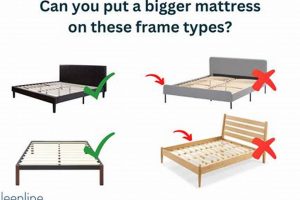
The question of whether one mattress size can be used with a different bed frame size is a common one. A full-size, sometimes referred to as a double, bed frame is designed to accommodate a mattress measuring approximately 54 inches wide by 75 inches long. In contrast, a queen-size mattress is larger, measuring roughly 60 inches wide by 80 inches long. The dimensional difference makes it physically impossible to properly or safely support a queen-size mattress on a full-size bed frame.
Understanding the compatibility of mattress and frame sizes is important for several reasons. Attempting to force a larger mattress onto a smaller frame can result in inadequate support, potentially damaging both the mattress and the frame. This can lead to premature wear and tear, decreased comfort, and may even void warranties. Furthermore, an improperly supported mattress can present a safety hazard, increasing the risk of the mattress sliding off the frame.
Given this incompatibility, several considerations arise when selecting a bed frame and mattress. It is crucial to accurately measure both the frame’s interior dimensions and the mattress’s length and width before purchase. Furthermore, exploring the consequences of size mismatches, examining solutions for individuals seeking to upgrade mattress sizes without replacing their existing bed frame, and understanding the implications for beddings such as sheets and comforters are all relevant topics for further discussion.
Tips Regarding Mattress and Frame Compatibility
Ensuring the correct mattress size for a bed frame is crucial for comfort, support, and the longevity of both items. The following tips provide guidance on assessing and addressing this issue.
Tip 1: Measure Accurately: Prior to purchasing a mattress or bed frame, obtain precise measurements of the frame’s interior dimensions and the mattress’s length and width. These measurements are essential to confirm a proper fit and avoid incompatibility.
Tip 2: Consult Manufacturer Specifications: Always refer to the manufacturer’s specifications for both the mattress and the bed frame. These specifications often provide detailed information about compatible sizes and weight limits, ensuring optimal performance and preventing damage.
Tip 3: Acknowledge Dimensional Differences: Be aware of the standard size differences between mattress types. A full-size bed frame is not designed to accommodate the additional width and length of a queen-size mattress; attempting to force the fit can lead to structural issues.
Tip 4: Assess Support Systems: Examine the bed frame’s support system to ensure it is adequate for the mattress weight. Inadequate support can cause the mattress to sag or wear unevenly, potentially reducing its lifespan and affecting sleep quality.
Tip 5: Evaluate Room Size: Before upgrading to a larger mattress, consider the room’s dimensions. A queen-size mattress requires more floor space than a full-size, and ensuring sufficient clearance around the bed is important for ease of movement and overall room functionality.
Tip 6: Investigate Bedding Compatibility: Note that bedding, such as sheets and comforters, are specifically sized to fit particular mattresses. If attempting to use a queen-size mattress on an inappropriately sized frame, existing bedding will likely not fit correctly, necessitating additional purchases.
Adhering to these tips will help ensure the selection of appropriately sized components, resulting in a comfortable and supportive sleep environment. It is crucial to prioritize proper fit to maximize the benefits of both the mattress and the bed frame.
With a solid understanding of how to use mattress and frame compatibility, one can confidently make informed choices when purchasing a new bed. The next step is to address the practical application of the provided insights and the potential solutions to overcome such challenges.
1. Dimension Incompatibility

Dimension incompatibility forms the core reason a full-size bed frame cannot properly accommodate a queen-size mattress. A full-size bed frame is designed with specific interior dimensions to support a mattress measuring approximately 54 inches wide and 75 inches long. A queen-size mattress, in contrast, is significantly larger, spanning approximately 60 inches wide and 80 inches long. This difference in dimensions means that a queen mattress will overhang a full-size frame, lacking necessary support. The unsupported overhang creates an unstable sleeping surface, increasing the risk of mattress damage and potential injury to the user. The issue is not simply one of aesthetic preference; the structural integrity of the entire bed system is compromised when dimensions are mismatched.
The consequences of dimension incompatibility extend beyond mere inconvenience. Attempting to force a queen mattress onto a smaller full-size frame can lead to a variety of practical problems. For instance, the mattress may sag or distort over time due to inadequate support, reducing its overall lifespan and comfort. Furthermore, the frame itself may be subjected to undue stress, potentially causing warping, bending, or even breakage. In real-world terms, this could mean a compromised sleep experience, increased replacement costs for both the mattress and the frame, and a heightened risk of accidents related to structural failure. This dimensional discordance inevitably undermines the functionality and longevity of the bedding setup.
Understanding the dimension incompatibility between a full-size bed frame and a queen-size mattress is fundamental to ensuring a safe and supportive sleep environment. The six-inch difference in width and five-inch difference in length represents a critical deviation that directly impacts the stability and durability of the bed. Recognizing this incompatibility prevents costly mistakes, mitigates potential hazards, and underscores the importance of precise measurements and adherence to manufacturer guidelines when selecting bedding components. By acknowledging these dimensional constraints, individuals can make informed decisions that promote both comfort and safety.
2. Structural Integrity

The structural integrity of a bed frame is fundamentally compromised when an inappropriately sized mattress is used. A full-size bed frame, designed to support a smaller mattress, cannot adequately bear the weight and dimensions of a queen-size mattress. This mismatch results in uneven weight distribution, placing undue stress on specific points of the frame. The direct consequence of this stress is potential damage, including bending, warping, or even breakage of the frame components. The joints and supporting structures, engineered for a defined load, are forced to endure forces beyond their design capacity. This ultimately weakens the frame’s structural integrity, significantly reducing its lifespan and potentially leading to catastrophic failure. For example, the center support beam, critical for maintaining levelness, may buckle under the excessive weight, causing the mattress to sag and creating an unstable sleeping surface.
Furthermore, the structural compromise extends to the overall stability of the bed. A queen-size mattress, overhanging the edges of a full-size frame, creates a lever effect. Any movement or weight applied to the overhanging portion increases the stress on the frame, accelerating the degradation of its structural components. This is particularly relevant in scenarios involving multiple occupants or significant movement during sleep. The long-term effect of this continued stress is a gradual weakening of the frame, manifested as squeaking, wobbling, or eventual collapse. Addressing this issue requires either downsizing to a properly sized mattress or upgrading to a bed frame engineered to support the dimensions and weight of a queen-size mattress. Failure to do so can result in not only structural damage but also potential injury to the occupants.
In summary, the connection between structural integrity and the question of fitting a queen-size mattress on a full-size bed frame is one of direct cause and effect. The dimensional mismatch inevitably leads to compromised structural integrity, resulting in potential damage, reduced lifespan, and safety hazards. Understanding this fundamental relationship is crucial for making informed decisions regarding bedding selection and ensuring a safe and supportive sleep environment. The practical significance lies in preventing costly repairs, avoiding potential injuries, and maximizing the longevity of both the mattress and the bed frame by adhering to specified size guidelines.
3. Mattress Support

Mattress support, a crucial determinant of sleep quality and mattress longevity, is directly compromised when attempting to use a queen-size mattress on a full-size bed frame. A full-size frame lacks the necessary dimensions to adequately support the larger queen mattress, resulting in an uneven distribution of weight and inadequate support across the mattress surface. This deficiency manifests as sagging in unsupported areas, often along the edges and in the center, negatively impacting spinal alignment and overall sleep comfort. For example, without proper edge support, individuals may experience a feeling of rolling off the bed, leading to interrupted sleep and potential physical discomfort. The practical significance lies in understanding that proper mattress support is not merely a matter of preference but a fundamental requirement for both physical well-being and the prolonged lifespan of the mattress itself. The absence of adequate support accelerates wear and tear, potentially voiding warranties and necessitating premature replacement.
The consequences of inadequate mattress support extend beyond immediate comfort concerns. Over time, the uneven weight distribution can cause internal damage to the mattress’s springs or foam layers. This damage compromises the mattress’s ability to provide consistent support, leading to chronic back pain and discomfort. Furthermore, the unsupported edges of the queen mattress may deform permanently, creating a sloped sleeping surface. Consider the example of a memory foam mattress, which relies on uniform support to maintain its shape and contouring properties; when placed on an undersized frame, these properties are severely diminished, negating the benefits of the mattress’s design. Therefore, ensuring proper mattress support is essential for preserving the mattress’s intended function and preventing long-term physical discomfort.
In summary, the relationship between mattress support and bed frame size is critical. Attempting to use a queen-size mattress on a full-size bed frame invariably results in inadequate support, leading to compromised sleep quality, accelerated mattress wear, and potential physical discomfort. Understanding this connection highlights the importance of selecting a bed frame that is specifically designed to accommodate the dimensions and weight of the chosen mattress. Prioritizing proper mattress support is an investment in both long-term comfort and the extended lifespan of the bedding components. The practical implications underscore the need for careful consideration and adherence to manufacturer guidelines when selecting a bed frame and mattress combination.
4. Frame Stress

When a queen-size mattress is placed on a full-size bed frame, the resulting frame stress becomes a significant concern. A full-size frame is engineered to bear the weight and dimensions of a mattress approximately 54 inches wide and 75 inches long. Imposing a queen mattress, which measures about 60 inches wide and 80 inches long, introduces forces the frame was not designed to withstand. This dimensional incompatibility leads to an uneven distribution of weight, concentrating stress on specific points, particularly the edges and center supports. The cause is clear: the frame’s inherent design cannot accommodate the larger mattress without exceeding its load-bearing capacity. An example of this is a visible bowing or bending in the side rails of the frame, especially noticeable in wooden frames. The practical significance is that over time, this elevated stress can lead to structural failure, reducing the frame’s lifespan and potentially creating a safety hazard.
Further exacerbating the issue, the overhanging portion of the queen mattress creates a lever effect, amplifying the stress on the frame. Every movement on the mattress, particularly near the edges, increases the force applied to the frame’s joints and supports. This constant strain can weaken the connections, causing them to loosen or break. Metal frames may experience fatigue and eventual cracking, while wooden frames are susceptible to splitting or warping. The importance of understanding frame stress in this context lies in recognizing that it’s not simply a matter of aesthetics. The structural integrity of the entire bed system is at risk, potentially leading to instability and a compromised sleep environment. Regularly inspecting the frame for signs of stress, such as cracks, bends, or loose joints, can help identify potential problems early on.
In summary, the interplay between frame stress and the improper fitting of a queen-size mattress onto a full-size bed frame is detrimental. The resulting stress compromises the frame’s structural integrity, shortening its lifespan and posing safety risks. Adhering to recommended size guidelines is crucial for ensuring the longevity of the bed frame and the safety of its occupants. The challenges associated with frame stress highlight the need for a bed frame that is specifically designed to support the dimensions and weight of the intended mattress, avoiding the potential consequences of an incompatible pairing. By recognizing the impact of frame stress, individuals can make informed decisions about bedding selection and create a safer, more supportive sleep environment.
5. Safety Hazard

A significant safety hazard arises when attempting to use a queen-size mattress on a full-size bed frame. The dimensional mismatch creates an unstable sleep surface, increasing the risk of falls and injuries. The overhanging portion of the mattress lacks proper support, making it prone to sagging or tipping, especially when weight is applied near the edges. This instability can lead to individuals rolling off the bed unexpectedly, particularly during sleep. For example, a child or elderly person is especially vulnerable to injury if the mattress shifts or collapses due to inadequate support. This scenario underscores the importance of proper frame and mattress compatibility for ensuring a safe sleep environment. The physical consequences of such falls can range from minor bruises and sprains to more severe injuries, depending on the individual’s age and physical condition.
The safety hazard extends beyond the immediate risk of falls. An improperly supported mattress can also create a hazardous situation for individuals moving around the bed in the dark. The uneven surface and potential for the mattress to shift unexpectedly can increase the risk of trips and stumbles. Moreover, the compromised structural integrity of the frame, as discussed previously, can lead to sudden collapses or breakage, posing a direct physical threat to anyone in close proximity. Consider the scenario where a frame, weakened by the stress of an oversized mattress, breaks while someone is sitting on the edge of the bed. The sudden collapse could cause the individual to fall and sustain injuries from the broken frame components. Therefore, the potential for structural failure adds another layer of concern to the safety hazard created by an incompatible mattress and frame.
In summary, the safety hazard associated with attempting to fit a queen-size mattress on a full-size bed frame is multifaceted and potentially serious. The instability, risk of falls, and compromised structural integrity of the frame all contribute to a dangerous sleep environment. Recognizing these risks underscores the importance of selecting properly sized bedding components and adhering to manufacturer guidelines. The challenges associated with creating a safe and supportive sleep environment highlight the need for careful consideration and a commitment to prioritizing safety over convenience or cost savings. Ultimately, ensuring proper frame and mattress compatibility is a fundamental step in preventing injuries and creating a secure sleeping space.
6. Warranty Void
The use of an improperly sized bed frame, specifically attempting to fit a queen mattress on a full-size frame, can directly result in the voiding of warranties for both the mattress and the frame. Most manufacturers establish specific guidelines regarding the appropriate support structure for their products. These guidelines often include dimensional requirements, weight limits, and stipulations regarding the type of foundation necessary for optimal performance and longevity. Deviating from these specifications, such as using a frame that is too small for the mattress, can be interpreted as misuse or improper care. This, in turn, can provide grounds for the manufacturer to deny warranty claims related to defects, sagging, or structural failures. For example, if a queen mattress develops significant sagging in the center while used on a full-size frame, the manufacturer may refuse to honor the warranty, citing the lack of adequate support as the cause.
Warranty voidance represents a significant financial risk for consumers. Mattresses and bed frames are substantial investments, and warranties provide a degree of protection against manufacturing defects or premature wear. However, this protection is contingent upon adhering to the manufacturer’s usage guidelines. In the case of a voided warranty, the consumer bears the full cost of repair or replacement, which can be substantial. Moreover, even if a warranty claim is initially approved, the manufacturer may later discover the use of an improper frame size, leading to a rescission of the claim and the demand for reimbursement of any costs incurred. Therefore, understanding and adhering to the manufacturer’s specifications regarding frame size is crucial for preserving the validity of warranties and mitigating potential financial losses. It also represents an incentive to check the fine print of the products we purchased.
In conclusion, the use of a full-size bed frame with a queen mattress carries the considerable risk of voiding the warranties for both items. Manufacturers’ guidelines regarding proper support structures are designed to ensure product performance and longevity, and deviations from these guidelines can be grounds for denying warranty claims. This potential financial consequence underscores the importance of careful consideration and adherence to manufacturer specifications when selecting bedding components. By prioritizing compatibility and following recommended usage practices, consumers can protect their investments and avoid the costly repercussions of a voided warranty. It is always advisable to consult the warranty documentation and manufacturer’s recommendations before making any decisions about bed frame and mattress pairings.
Frequently Asked Questions
The following addresses frequently encountered questions regarding the interchangeability of bed frame and mattress sizes. It provides essential information to clarify the compatibility limitations between full and queen-size bedding components.
Question 1: Is it physically possible to place a queen-size mattress on a full-size bed frame?
No, it is not physically advisable to place a queen-size mattress on a full-size bed frame. The queen-size mattress dimensions exceed those of the full-size frame, resulting in an overhang that lacks proper support.
Question 2: What are the potential consequences of forcing a queen mattress onto a smaller frame?
Attempting to force a larger mattress onto a smaller frame may cause damage to both the mattress and the frame, leading to structural instability and potentially voiding warranties.
Question 3: Will a queen-size mattress fit if the full-size frame has slats?
The presence of slats on a full-size frame does not alter the dimensional incompatibility with a queen-size mattress. The mattress will still overhang the frame, regardless of the slat configuration.
Question 4: Can an adapter or modification allow a queen mattress to fit on a full-size frame?
Modifications or adapters are generally not recommended as they may compromise the frame’s structural integrity and potentially create a safety hazard. Such alterations may also void warranties.
Question 5: How does using an oversized mattress affect the lifespan of the bed frame?
Using an oversized mattress places undue stress on the bed frame, potentially accelerating wear and tear and significantly reducing its lifespan. Over time, joints and supports may weaken or fail.
Question 6: Are there any safety concerns associated with using an incompatible mattress and frame size?
Yes, an unstable sleeping surface can create a safety hazard, increasing the risk of falls and injuries, particularly for children, the elderly, or individuals with mobility issues.
In essence, proper mattress and frame compatibility is crucial for ensuring comfort, safety, and product longevity. Any attempt to circumvent these guidelines may have adverse consequences.
Understanding these points sets the stage for discussing alternative solutions and recommendations for achieving optimal bedding configurations.
Assessing Bed Frame and Mattress Compatibility
The exploration of whether a full-size bed frame can fit a queen mattress reveals a clear incompatibility. Dimensional differences and the resulting compromises to structural integrity, mattress support, and user safety preclude the use of a queen mattress on a smaller full-size frame. Furthermore, warranty implications reinforce the need to adhere to specified size guidelines.
Therefore, careful consideration of bed frame and mattress compatibility is essential for ensuring optimal sleep quality, safety, and product longevity. Prioritizing accurate measurements and adherence to manufacturer recommendations represents a prudent investment in a stable and supportive sleep environment. Future decisions should be based on a thorough assessment of size requirements to prevent the adverse consequences of mismatched bedding components.

![Ultimate King Size Bed Frame with Mattress [Deals] | Organic & Natural Mattress Buyer’s Guide: Non-Toxic Sleep Solutions](https://mattressworldpa.com/wp-content/uploads/2025/07/th-3215-300x200.jpg "Ultimate King Size Bed Frame with Mattress [Deals] Organic & Natural Mattress Buyer’s Guide: Non-Toxic Sleep Solutions")
![Best Queen Frame with Air Mattress [Deals!] | Organic & Natural Mattress Buyer’s Guide: Non-Toxic Sleep Solutions](https://mattressworldpa.com/wp-content/uploads/2025/07/th-3213-300x200.jpg "Best Queen Frame with Air Mattress [Deals!] Organic & Natural Mattress Buyer’s Guide: Non-Toxic Sleep Solutions")