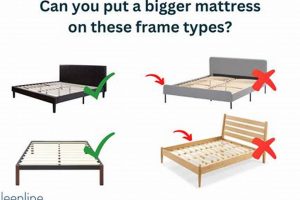
A self-constructed support structure for a mattress, often built from readily available materials, provides an alternative to commercially manufactured bed frames. These structures can range from simple platforms built with wooden pallets to more complex designs incorporating headboards, storage, or unique aesthetic features. A basic example involves assembling a rectangular frame from lumber and adding cross-supports for mattress stability.
Choosing to build a mattress foundation presents several advantages, including cost savings, customization options, and the potential to utilize reclaimed or repurposed materials. This approach allows for a bed frame tailored to specific room dimensions, desired height, and preferred style. Historically, self-sufficiency and resourcefulness have driven individuals to create their own furniture, and constructing a bed frame represents a continuation of this tradition.
The subsequent discussion will explore various design approaches, material considerations, and construction techniques relevant to building a sturdy and aesthetically pleasing base for a mattress. Considerations will include material selection for durability and aesthetic appeal, along with techniques to ensure proper support and longevity of the finished structure.
Construction Considerations for a Self-Made Mattress Base
The following recommendations are intended to improve the structural integrity, longevity, and overall satisfaction derived from creating a bed frame independently.
Tip 1: Material Selection. Choose hardwoods like oak or maple for primary structural components to maximize durability and resistance to warping. Softwoods, such as pine, may be suitable for aesthetic elements or non-load-bearing sections.
Tip 2: Precise Measurements. Accurately measure the mattress dimensions to ensure a snug yet accessible fit within the frame. Account for potential expansion or contraction of the materials due to environmental factors.
Tip 3: Reinforcement Strategies. Employ corner braces and center supports to prevent sagging and distribute weight evenly across the frame. Consider adding a central support beam for larger mattresses, particularly those made of memory foam.
Tip 4: Secure Fastening. Utilize high-quality screws and wood glue to ensure joints are strong and resistant to separation. Avoid using nails alone, as they can loosen over time. Predrill holes to prevent splitting the wood.
Tip 5: Surface Treatment. Apply a sealant or finish to protect the wood from moisture, scratches, and stains. Consider the aesthetic impact of the chosen finish on the overall bedroom design.
Tip 6: Adequate Ventilation. Design the frame to allow for air circulation beneath the mattress, preventing moisture buildup and potential mold growth. Slatted platforms or widely spaced supports can facilitate airflow.
Tip 7: Headboard and Footboard Integration. When adding a headboard or footboard, ensure they are securely attached to the frame using appropriate hardware and reinforcement. Distribute the weight evenly to prevent strain on the frame’s structure.
Adhering to these guidelines can significantly enhance the quality and lifespan of a self-constructed mattress base, offering a durable and aesthetically pleasing alternative to commercially available options.
The following section will address various design styles and explore options for incorporating storage or other functional elements into the bed frame design.
1. Material Selection

The selection of materials forms the foundational basis for any self-constructed mattress base, dictating its structural integrity, aesthetic qualities, and overall longevity. Careful consideration must be given to the properties of each material in relation to the intended design and expected usage.
- Wood Type and Durability
The choice of wood significantly impacts the frame’s resistance to wear and tear. Hardwoods such as oak, maple, or birch offer superior strength and resistance to warping compared to softwoods like pine or fir. For example, a frame constructed from kiln-dried oak is more likely to withstand prolonged use and heavy loads without deformation than a frame built from untreated pine. This difference is crucial for long-term structural stability.
- Fastener Compatibility
Different materials exhibit varying degrees of compatibility with fasteners like screws and nails. Hardwoods generally require pre-drilling to prevent splitting, while softwoods may be more susceptible to pull-through. Selecting the appropriate fastener type and size is critical to ensure secure and lasting connections. An improper choice can compromise the frame’s structural integrity over time.
- Finish and Treatment Receptivity
The ability of a material to accept finishes and treatments affects its resistance to moisture, pests, and aesthetic appeal. Hardwoods typically accept stains and sealants more evenly than softwoods, resulting in a more professional and durable finish. Applying a suitable protective coating is essential to prolong the lifespan of the frame and prevent deterioration due to environmental factors.
- Cost and Availability
Material costs and ease of acquisition often play a significant role in the selection process. While hardwoods may offer superior performance, they can be more expensive and less readily available than softwoods. Balancing performance requirements with budgetary constraints is essential. Locally sourced or reclaimed materials can provide cost-effective and sustainable alternatives.
In summary, material selection represents a pivotal decision in the construction of a self-made mattress base. Understanding the inherent properties of different materials, their compatibility with fasteners and finishes, and their associated costs allows for a well-informed choice that balances structural integrity, aesthetic preferences, and budgetary considerations. The resulting frame will be more likely to provide reliable support and lasting satisfaction.
2. Structural Integrity

Structural integrity is paramount in the context of a self-constructed mattress foundation. The absence of adequate structural design principles leads to premature failure, compromised support, and potential safety hazards. For example, a frame lacking sufficient central support beams may exhibit significant sagging under the weight of a mattress and occupants, leading to discomfort and potentially damaging the mattress itself. This can be further exacerbated with larger mattresses or heavier individuals. Proper structural design mitigates these risks.
The selection of appropriate joinery techniques directly impacts the structural resilience of a self-made frame. Simple butt joints secured with nails offer minimal resistance to shear forces, while more robust joinery methods like mortise-and-tenon or reinforced miter joints provide significantly greater stability. Employing high-quality fasteners, such as screws with substantial thread engagement, further enhances the frame’s ability to withstand repeated stress cycles. A real-world consequence of inadequate joinery is the development of creaking or instability over time, indicating a weakening of the frame’s structural connections.
In conclusion, maintaining the load-bearing capacity, longevity, and safe operation of a self-constructed mattress base is dependent on structural integrity. This can be achieved through careful material selection, thorough planning, and the use of appropriate joinery. Addressing the structural considerations mitigates risks and offers a stable alternative to commercially manufactured options.
3. Size Accuracy

Size accuracy is a foundational element in the successful construction of a self-made mattress base. Deviation from precise measurements can lead to a multitude of functional and aesthetic issues, undermining the overall utility and satisfaction derived from the project. Inaccurate dimensions directly impact the mattress fit, potentially resulting in a base that is either too small, causing the mattress to overhang and lose support, or too large, allowing the mattress to shift and creating an unstable sleeping surface. This misalignment not only compromises comfort but can also accelerate mattress wear and tear.
The consequences of inaccurate measurements extend beyond the immediate issue of mattress fit. A base constructed with incorrect dimensions may not properly integrate into the intended bedroom space, disrupting the flow of the room and creating visual disharmony. Furthermore, if storage elements are incorporated into the design, dimensional errors can render drawers or compartments unusable. Consider the example of a base designed to accommodate a standard queen-size mattress (60 inches wide by 80 inches long). Even a small error of half an inch can create noticeable discrepancies that affect stability and aesthetic appearance. Cumulative errors across multiple frame components can compound the problem, resulting in a final product that deviates substantially from the initial design.
In conclusion, the relationship between accurate size measurements and the functionality of a self-made mattress base is direct and consequential. Precise measurements are not merely a matter of aesthetic preference but rather a fundamental requirement for ensuring proper mattress support, structural stability, and seamless integration into the intended environment. Prioritizing accurate measurements and employing reliable measuring tools and techniques are essential steps in any construction project. Attention to accurate size measurement is a critical success factor for a homemade mattress base.
4. Joint Strength
Joint strength represents a critical determinant of the longevity and stability of any self-constructed mattress base. The integrity of the frame’s joints directly dictates its capacity to withstand the sustained loads imposed by the mattress and its occupants. Inadequate joint construction inevitably leads to structural failure, manifested as sagging, creaking, or complete collapse. For instance, a frame utilizing only butt joints secured with brad nails will exhibit significantly reduced resistance to racking forces compared to a frame incorporating mortise-and-tenon or dovetail joinery reinforced with structural adhesives. The connection between joint strength and the overall performance of the mattress base is therefore both direct and fundamental. The effect that Joint Strength has on DIY mattress frame affects cost saving and overall safety.
The choice of joinery technique must be carefully considered in relation to the anticipated load and the properties of the chosen materials. Hardwoods, while offering superior overall strength, may necessitate more robust joinery methods due to their resistance to fastener penetration. Conversely, softwoods, while easier to work with, require careful reinforcement to prevent joint failure under stress. The use of metal fasteners, such as screws or bolts, can significantly enhance joint strength, particularly when combined with structural adhesives that fill gaps and distribute stress more evenly across the joint surface. One example of practical significance is the reinforcement of corner joints with metal brackets or gussets to prevent racking and maintain the squareness of the frame over time. Joint strength ensures a bedframe remains solid for long periods of time, offering comfort and safety to end user.
In summary, joint strength is non-negotiable for a stable and durable self-made mattress frame. Understanding the principles of sound joinery and selecting appropriate techniques and materials are crucial steps in the construction process. Addressing joint strength not only enhances the longevity and performance of the mattress base but also ensures the safety and comfort of its users. The main challenge is understanding the correct methods to apply these different joints together while mainting a cohesive look, and structural integrity. The application of joints ties into the overall success of a DIY mattress frame.
5. Ventilation
Ventilation, in the context of a self-constructed mattress base, represents a critical design element directly influencing the longevity of both the frame and the mattress itself. The absence of adequate airflow beneath the mattress creates an environment conducive to moisture accumulation, primarily from perspiration and ambient humidity. This trapped moisture, in turn, fosters the growth of mold and mildew, compromising air quality and potentially causing allergic reactions or respiratory problems for the occupants. The connection, therefore, is causal: inadequate ventilation leads to increased moisture, which leads to microbial growth. This underscores the importance of prioritizing airflow in the design and construction phases.
Several design strategies effectively promote ventilation. Slatted platforms, constructed with spaces between each slat, provide ample opportunity for air circulation. Similarly, open-frame designs, which minimize the surface area in contact with the mattress, facilitate airflow. Incorporating ventilation holes or channels into solid platform designs can also mitigate moisture buildup. In contrast, solid, airtight platforms create a breeding ground for moisture, especially in humid climates. A practical example involves comparing two identical mattresses placed on different frame types: one on a slatted frame and the other on a solid platform. Over time, the mattress on the solid platform will likely exhibit signs of mold or mildew growth, while the mattress on the slatted frame will remain drier and cleaner.
In summary, ensuring adequate ventilation in a self-made mattress base is not merely a matter of aesthetic preference but a fundamental requirement for maintaining a healthy and hygienic sleep environment. Challenges in achieving optimal ventilation include balancing airflow with structural stability and aesthetic considerations. However, prioritizing ventilation through thoughtful design choices and construction techniques will extend the lifespan of the mattress and promote a healthier sleeping experience. A slatted design provides adequate support while also allowing for air to flow freely. A solid frame limits airflow, but is easier to create, resulting in a difficult decision for most users.
6. Design Aesthetics
Design aesthetics constitutes a critical element in the construction of a self-made mattress base, extending beyond mere functionality to encompass the visual appeal and integration of the frame within the overall bedroom environment. A mattress base, while fundamentally intended for support, can also serve as a focal point that reflects personal style and complements existing dcor. Therefore, the aesthetic considerations in this project demand as much attention as the practical construction methods.
- Material Selection and Visual Texture
The choice of materials exerts a substantial influence on the aesthetic outcome of the frame. Different wood types, for example, possess distinct grain patterns and color variations that contribute to the overall visual texture. Reclaimed wood offers a rustic aesthetic, while hardwoods like walnut or cherry provide a more refined and elegant appearance. The surface finishwhether a natural oil, stain, or paintfurther refines the visual texture and allows for customization to match existing bedroom furniture and color palettes. This careful selection ensures the base complements the space, adding character to the room.
- Form and Proportionality
The overall form and dimensions of the frame significantly impact its aesthetic appeal. A low-profile platform bed offers a modern, minimalist aesthetic, while a taller frame with a headboard evokes a more traditional feel. Proportionalitythe relationship between the height, width, and depth of the frameis crucial for achieving visual harmony. A frame that is disproportionately large or small in relation to the mattress or the room itself can appear unbalanced and detract from the overall aesthetic. Thoughtful consideration of these relationships helps create a visually balanced and pleasing structure.
- Hardware and Detailing
The selection of hardware and detailing elements, such as fasteners, corner brackets, and decorative trim, contribute to the overall aesthetic. Exposed hardware can impart an industrial or rustic aesthetic, while concealed fasteners offer a cleaner, more streamlined appearance. Decorative trim, such as molding or carving, can add visual interest and character to the frame. The style and finish of these elements should complement the overall design and materials used in the construction of the base, increasing the visual appeal, creating a customized element.
- Integration with Surrounding Space
The aesthetic success of a self-made mattress base hinges on its seamless integration with the surrounding bedroom space. This involves considering factors such as room size, lighting, and existing furniture styles. A minimalist frame may be ideal for a small, contemporary bedroom, while a more elaborate frame with a headboard may be better suited for a larger, more traditional space. Ensuring that the frame’s aesthetic complements the room’s overall design creates a cohesive and visually appealing environment, which makes the frame appear as an important and valuable part of the bedroom.
In summary, design aesthetics constitutes an integral component of the self-made mattress base, influencing not only its visual appeal but also its integration within the broader bedroom environment. Attention to material selection, form, hardware, and spatial integration is essential for creating a frame that is both functional and aesthetically pleasing. The final result will be a reflection of individual style while still maintaining the usefulness of a mattress frame.
Frequently Asked Questions
The following section addresses common inquiries and misconceptions surrounding the construction and utilization of do-it-yourself mattress frames, offering guidance and clarification on critical aspects.
Question 1: Is a self-constructed mattress base as durable as a commercially manufactured one?
The durability of a self-constructed mattress base depends primarily on the quality of materials used, the chosen design, and the precision of construction. A well-designed and properly built frame utilizing durable materials can equal or surpass the durability of some commercially produced options.
Question 2: What are the essential tools required for building a mattress frame?
Essential tools typically include a circular saw or hand saw for cutting materials to size, a drill for creating pilot holes and driving screws, a measuring tape for accurate measurements, a level for ensuring a flat and stable surface, and appropriate safety equipment such as safety glasses and gloves.
Question 3: How does one ensure proper support for a mattress on a self-made frame?
Proper support is achieved through the strategic placement of support beams or slats beneath the mattress. The spacing between these supports should be determined by the mattress type and weight, with closer spacing providing greater support. A central support beam is often necessary for larger mattresses.
Question 4: What are the potential cost savings associated with constructing a mattress base?
Cost savings can be significant, particularly when utilizing reclaimed or locally sourced materials. The primary savings derive from avoiding retail markups and labor costs associated with commercially manufactured frames. However, material costs and the investment in necessary tools must be considered.
Question 5: Are there specific design considerations for different types of mattresses (e.g., memory foam vs. innerspring)?
Yes. Memory foam mattresses typically require a solid or closely spaced slatted support surface to prevent sagging. Innerspring mattresses may be more forgiving and can be used with wider slat spacing. Understanding the specific support requirements of the chosen mattress is crucial.
Question 6: How does one address potential squeaking or creaking issues in a self-made mattress frame?
Squeaking or creaking often results from friction between frame components. Applying lubricant to joints, tightening fasteners, or adding felt pads between contacting surfaces can mitigate these noises. Addressing these issues promptly prevents further structural degradation.
These FAQs provide essential considerations for those undertaking the construction of a mattress base, ensuring a safe, durable, and cost-effective outcome.
The next section will delve into advanced design techniques, including integration of storage solutions and custom aesthetic enhancements.
DIY Mattress Frame
The preceding exploration of the “diy mattress frame” concept has illuminated critical aspects ranging from material selection and structural integrity to size accuracy, joint strength, ventilation, and design aesthetics. These factors collectively determine the success of a self-constructed mattress support system. A clear understanding of these elements facilitates the creation of a durable, functional, and aesthetically pleasing alternative to commercially available options.
Constructing a foundation independently presents opportunities for customization and cost savings. However, success necessitates diligence and precision. The long-term value lies in the ability to tailor a bed frame to specific needs and preferences, provided sound construction principles are meticulously followed. Further research and careful planning are encouraged before embarking on this project.
![Ultimate King Size Bed Frame with Mattress [Deals] | Organic & Natural Mattress Buyer’s Guide: Non-Toxic Sleep Solutions](https://mattressworldpa.com/wp-content/uploads/2025/07/th-3215-300x200.jpg "Ultimate King Size Bed Frame with Mattress [Deals] Organic & Natural Mattress Buyer’s Guide: Non-Toxic Sleep Solutions")
![Best Queen Frame with Air Mattress [Deals!] | Organic & Natural Mattress Buyer’s Guide: Non-Toxic Sleep Solutions](https://mattressworldpa.com/wp-content/uploads/2025/07/th-3213-300x200.jpg "Best Queen Frame with Air Mattress [Deals!] Organic & Natural Mattress Buyer’s Guide: Non-Toxic Sleep Solutions")