![Best Value: 4 Inch Foam Mattress [Deals Inside!]](data:image/svg+xml;base64,PHN2ZyB4bWxucz0iaHR0cDovL3d3dy53My5vcmcvMjAwMC9zdmciIHdpZHRoPSI0NzQiIGhlaWdodD0iNzMiIHZpZXdCb3g9IjAgMCA0NzQgNzMiPjxyZWN0IHdpZHRoPSIxMDAlIiBoZWlnaHQ9IjEwMCUiIHN0eWxlPSJmaWxsOiNjZmQ0ZGI7ZmlsbC1vcGFjaXR5OiAwLjE7Ii8+PC9zdmc+ "Best Value: 4 Inch Foam Mattress [Deals Inside!] Organic & Natural Mattress Buyer’s Guide: Non-Toxic Sleep Solutions")
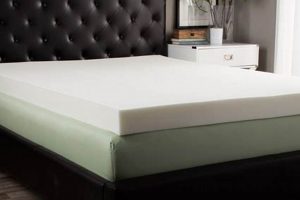
A sleep surface composed of flexible polyurethane or viscoelastic foam, measuring approximately four inches in thickness, is often employed as an economical and space-saving bedding solution. These products are typically utilized as mattress toppers, guest beds, or in situations where portability is prioritized.
The appeal of thinner foam bedding stems from its affordability, ease of storage, and lighter weight compared to traditional innerspring or thicker foam mattresses. Historically, thinner foam options became prevalent as material science advanced, allowing for adequate comfort and support within reduced dimensions. Their suitability for temporary use or in environments with limited space contributes to their ongoing demand.
The subsequent sections will delve into specific considerations when selecting a foam sleep surface of this dimension, including density, Indentation Load Deflection (ILD) ratings, and potential applications, thus providing a comprehensive guide for informed decision-making.
Considerations for a Thin Foam Sleep Surface
Selecting a flexible polyurethane or viscoelastic bedding option requires careful evaluation to ensure optimal comfort and longevity. Prioritize key factors to avoid dissatisfaction.
Tip 1: Density Assessment: Higher density foam typically correlates with increased durability and support. Inquire about the foam’s density rating (measured in pounds per cubic foot) before purchase. A density of 1.5 lbs/cubic foot or higher is generally recommended for acceptable performance.
Tip 2: Indentation Load Deflection (ILD) Evaluation: The ILD rating indicates the firmness level. Lower ILD values suggest a softer feel, while higher values indicate greater firmness. Choose an ILD rating that aligns with individual sleep preferences and body weight. Test in-store if possible.
Tip 3: Material Composition Awareness: Be cognizant of the foam’s composition. CertiPUR-US certification assures that the foam has been independently tested and certified to meet specific standards for content, emissions, and durability. This minimizes exposure to potentially harmful chemicals.
Tip 4: Support Requirements Analysis: A thin foam option provides limited support compared to thicker mattresses. Consider if the existing support structure (e.g., bed frame, box spring) is adequate to compensate for the mattress’s reduced thickness. Inadequate support can lead to discomfort and premature wear.
Tip 5: Intended Use Case Determination: Evaluate the primary purpose of the foam surface. For occasional use as a guest bed, a lower-density option may suffice. However, for nightly sleep or individuals requiring greater support, a higher-density foam with a firmer ILD rating is advisable.
Tip 6: Review Return Policies: Before finalizing a purchase, carefully review the retailer’s return policy. Many retailers offer trial periods or return options if the product does not meet expectations. This allows for risk mitigation if the selected foam surface proves unsuitable.
Careful consideration of density, firmness, composition, and support requirements will increase the likelihood of selecting a suitable foam surface. Understanding the intended use case and reviewing return policies further safeguards the purchase decision.
The following section will provide insights into the proper maintenance and care of thin foam surfaces to maximize their lifespan.
1. Affordability

The relationship between a four-inch foam mattress and affordability is fundamentally direct. The reduced material volume inherent in its design translates to lower manufacturing costs, making it a more accessible bedding option for individuals operating within restricted budgets. This is primarily due to the diminished quantity of raw materials (primarily polyurethane or viscoelastic foam) required for production. Consequently, retailers can offer these mattresses at significantly lower price points compared to thicker, more elaborate alternatives featuring innerspring systems, hybrid constructions, or higher-density foams.
The practical significance of this affordability extends to various demographics. Students, individuals in temporary housing situations, and those furnishing guest rooms often prioritize cost-effectiveness over long-term durability or specialized comfort features. The lower upfront investment associated with a four-inch foam mattress allows these consumers to acquire a functional sleep surface without incurring substantial financial burden. For example, a college student setting up a dorm room may opt for this mattress type to meet immediate needs while minimizing expenses. Similarly, individuals downsizing or temporarily relocating may find it a suitable, budget-friendly solution.
However, the trade-off for affordability is typically a reduction in support, longevity, and potentially, overall comfort. While providing a basic sleep surface, a four-inch foam mattress may not adequately address the needs of individuals requiring robust spinal alignment or those experiencing specific musculoskeletal issues. Ultimately, the cost savings must be weighed against the potential compromises in quality and suitability, necessitating a careful assessment of individual requirements and budgetary constraints. This balance underscores the critical role of informed consumer decision-making when considering a thin foam mattress.
2. Space Efficiency

Space efficiency, in the context of bedding solutions, refers to the maximization of usable area within a given physical footprint. The reduced vertical dimension inherent in a four-inch foam mattress directly contributes to its suitability for environments where spatial constraints are a primary consideration. This characteristic manifests in several key aspects:
- Storage Optimization
The diminished thickness of a four-inch foam mattress allows for more convenient storage compared to thicker mattresses. When not in use, it can be more easily compressed, rolled, or folded, facilitating storage in closets, under beds, or in dedicated storage units. This is particularly relevant in apartments, dorm rooms, or guest rooms where space is limited. For example, a four-inch foam mattress can be readily stored in a storage bag and placed on a high shelf, freeing up valuable floor space.
- Stacking and Multi-Use Applications
The relatively low profile of these mattresses enables the stacking of multiple units for compact storage or for creating a thicker sleep surface temporarily. This is often utilized in situations such as sleepovers, camping, or emergency bedding arrangements. Several mattresses can be stacked together, then separated when additional sleeping surfaces are required. This adaptability proves advantageous in environments where sleeping arrangements are dynamic and space optimization is paramount.
- Compatibility with Space-Saving Furniture
Four-inch foam mattresses are commonly paired with space-saving furniture such as platform beds, futons, or trundle beds. Their thinner profile is often a design requirement for these types of furniture, allowing for the full functionality of the piece without compromising the user’s comfort. In a trundle bed, for example, the mattress must be thin enough to allow the bed to slide underneath the main bed frame. The four-inch depth is often an ideal fit for this type of application.
- Minimized Visual Bulk
Even when in use, the lower profile of a thin foam mattress contributes to a less cluttered visual aesthetic within a room. This is particularly beneficial in smaller spaces where maximizing perceived space is crucial. A thicker mattress can visually dominate a room, whereas a thinner option integrates more seamlessly with the surrounding environment. The result is a more open and less confined ambiance.
In summation, the space efficiency afforded by a four-inch foam mattress is a significant attribute, making it a practical choice for individuals and environments prioritizing spatial economy. This characteristic extends beyond simple dimensional reduction, encompassing enhanced storage options, compatibility with space-saving furniture, and a less obtrusive visual presence within a room.
3. Limited Support

The characteristic of limited support is intrinsic to a flexible foam sleep surface measuring approximately four inches in thickness. This inherent limitation stems from the reduced volume of material available to distribute weight and provide adequate spinal alignment. The cause-and-effect relationship is straightforward: decreased material mass directly translates to diminished capacity for resisting compression and contouring effectively to the body’s natural curves. The absence of a substantial support core, commonly found in thicker mattresses containing innerspring systems or denser foam layers, means the sleep surface is less capable of preventing excessive sinkage, particularly for individuals with higher body mass or those who sleep in positions that concentrate pressure on specific areas, such as the hips or shoulders.
The practical significance of this limited support manifests in several potential consequences. Individuals may experience discomfort, particularly in the lower back, due to inadequate spinal alignment. The lack of sufficient support can exacerbate existing musculoskeletal issues or contribute to the development of new ones over time. For example, a person with a pre-existing back condition using a thin foam mattress may find their symptoms worsen due to the mattress’s inability to maintain proper spinal curvature. Furthermore, the reduced support can lead to uneven weight distribution, resulting in localized pressure points that disrupt sleep and cause restlessness. The importance of understanding this limitation lies in ensuring appropriate expectations and selecting this type of mattress only when the need for robust support is minimal or when used in conjunction with a supportive base.
In conclusion, the constraint of limited support is an unavoidable consequence of the design and material properties inherent in a thin foam mattress. This limitation should be carefully considered, particularly by individuals with specific support requirements or pre-existing health conditions. The understanding of this critical factor ensures appropriate application and prevents potential discomfort or adverse health effects associated with inadequate spinal alignment. The suitability of such a mattress is, therefore, largely dependent on the user’s individual needs and the intended context of use.
4. Density Dependent
The performance and longevity of a four-inch foam mattress are intrinsically linked to the density of the foam material. Density, measured in pounds per cubic foot (lbs/ft), serves as a primary indicator of foam quality and its ability to withstand prolonged use and compression. A higher density foam, within the confines of a four-inch thickness, will generally exhibit superior resistance to deformation, thereby maintaining its shape and providing consistent support over an extended period. Conversely, lower density foam is prone to rapid degradation, leading to sagging, reduced support, and ultimately, a shorter lifespan. The selection of an appropriate density is, therefore, paramount in maximizing the utility and value of a thin foam mattress. For example, a four-inch mattress made with 1.2 lbs/ft density foam may be suitable for occasional use, while a mattress with 1.8 lbs/ft density is better suited for nightly use.
The direct consequence of selecting a lower-density foam for a four-inch mattress is a diminished capacity for weight distribution. This results in concentrated pressure points, potentially causing discomfort and disrupting sleep. Additionally, lower density foams typically exhibit reduced resilience, meaning they recover less effectively from compression. This can lead to permanent indentations and a progressive loss of support, particularly in areas where weight is concentrated, such as the hips and shoulders. To illustrate, consider two mattresses of identical dimensions but differing densities. The higher-density mattress will distribute weight more evenly, minimizing pressure points and maintaining a more consistent surface profile, while the lower-density mattress will conform more readily to the body’s contours, potentially leading to a sensation of sinking and a compromised spinal alignment.
In summary, the density of the foam material is a critical determinant of the overall performance and durability of a four-inch foam mattress. While other factors such as firmness (ILD rating) and foam type (polyurethane, memory foam) also play a role, density remains a fundamental consideration. The selection process should prioritize higher-density foams to ensure adequate support, longevity, and resistance to deformation. This understanding is particularly important given the inherent limitations of a thin mattress, where material quality becomes even more crucial for delivering acceptable performance. Individuals requiring more robust support or those intending to use the mattress frequently should prioritize higher-density options, recognizing that this may entail a slightly higher initial investment that will be offset by the extended lifespan and improved comfort.
5. Portability Factor

The term “portability factor,” as it relates to a four-inch foam mattress, denotes the ease with which the mattress can be transported and relocated. This attribute is a significant consideration for individuals requiring a sleep surface that is readily moved, stored, or deployed in various settings. The reduced thickness and inherent flexibility of the mattress contribute to its enhanced portability, offering advantages over bulkier and less pliable alternatives.
- Lightweight Construction
The primary driver of the portability factor is the mattress’s lightweight construction. Employing foam as the sole material component, and further minimizing the thickness to four inches, substantially reduces the overall weight compared to innerspring or hybrid mattresses. This lighter weight facilitates easier handling during transport, making it practical for individuals to carry, load, and unload the mattress without requiring significant physical exertion or assistance. This is particularly relevant for students, travelers, or individuals frequently relocating.
- Compact Dimensions for Storage
The four-inch profile allows for more compact storage when the mattress is not in use. It can be readily rolled, folded, or compressed, thereby minimizing its storage footprint. This feature is advantageous in environments where space is limited, such as apartments, dormitories, or recreational vehicles. A rolled and secured mattress can be easily stowed in closets, under beds, or in designated storage compartments, optimizing the utilization of available space. Some mattresses may include compression straps to maintain a compact form during transit.
- Facilitates Temporary Sleeping Arrangements
The portability factor makes these mattresses ideally suited for temporary sleeping arrangements. They can be easily transported to accommodate guests, create makeshift beds during travel, or provide a comfortable sleep surface in camping or outdoor settings. The mattress’s pliability allows it to be conformed to various surfaces, offering a degree of adaptability that is not achievable with rigid mattress types. In emergency situations or when unexpected sleeping arrangements are necessary, the portable nature of the mattress provides a practical solution.
- Reduces Transportation Costs
The compact dimensions and lighter weight also translate to reduced transportation costs. Shipping or moving a four-inch foam mattress is generally less expensive compared to transporting thicker and heavier alternatives. This is due to lower shipping rates based on weight and volume, as well as reduced handling fees. Individuals who frequently relocate or require the mattress to be shipped to different locations can realize significant cost savings due to its portability.
These facets collectively highlight the significant role the portability factor plays in the practicality and versatility of a four-inch foam mattress. The combination of lightweight construction, compact storage dimensions, adaptability for temporary arrangements, and reduced transportation costs makes this mattress type a viable option for individuals prioritizing ease of movement and adaptability in their sleeping arrangements. The portability factor is, therefore, a defining characteristic that distinguishes this type of mattress from its bulkier and less manageable counterparts.
Frequently Asked Questions
The following addresses common inquiries regarding the selection, usage, and maintenance of a flexible foam sleep surface with a thickness of four inches.
Question 1: What is the typical lifespan of a four-inch foam mattress?
The longevity is variable and dependent on factors such as foam density, usage frequency, and user weight. Generally, a higher-density foam mattress used for occasional purposes may last several years. However, a lower-density option subjected to nightly use may exhibit signs of degradation within one to two years.
Question 2: Is a four-inch foam mattress suitable for individuals with back pain?
Suitability is contingent upon the specific nature and severity of the back pain, as well as individual preferences. A thin foam mattress generally provides less support than thicker alternatives and may not be adequate for individuals requiring substantial spinal alignment. Consultation with a medical professional is advisable to determine the most appropriate bedding solution.
Question 3: Can a four-inch foam mattress be used directly on the floor?
While direct floor placement is possible, it is generally not recommended. A supportive base, such as a platform bed or box spring, is preferable to promote air circulation and prevent moisture accumulation, which can lead to mold or mildew growth. Direct floor contact also reduces the mattress’s lifespan.
Question 4: What is the ideal foam density for a four-inch foam mattress intended for nightly use?
For regular use, a foam density of 1.5 pounds per cubic foot (lbs/ft) or higher is generally recommended. This density provides a reasonable balance of support and durability. Higher density options (e.g., 1.8 lbs/ft or greater) will offer enhanced support and longevity.
Question 5: How should a four-inch foam mattress be cleaned?
Spot cleaning with a mild detergent and water is recommended for localized stains. Avoid soaking the mattress, as excessive moisture can damage the foam. Allow the mattress to air dry completely before use. A mattress protector is advisable to prevent stains and spills.
Question 6: Does a four-inch foam mattress require a box spring?
A box spring is not strictly required, particularly if the mattress is placed on a platform bed or a solid foundation. However, a box spring can provide additional support and increase the mattress’s height, improving accessibility. The decision to use a box spring depends on individual preferences and the existing bed frame.
In summary, a four-inch flexible foam sleep surface presents both advantages and limitations. Its suitability depends on individual needs, intended use, and careful consideration of factors such as foam density and support requirements.
The subsequent section will provide a comparison of this bedding option against other mattress types available in the market.
Conclusion
This examination of the four-inch flexible foam sleep surface has underscored several key characteristics. Its affordability and portability render it a suitable choice for specific applications, such as temporary sleeping arrangements or situations where spatial constraints are paramount. However, the inherent limitations in support and durability necessitate careful consideration of individual needs and usage patterns. Foam density emerges as a critical determinant of performance, influencing both comfort and longevity. The decision to employ a sleep surface of this dimension warrants a thorough evaluation of these factors.
Ultimately, the ongoing evolution of material science may lead to advancements that mitigate some of the current limitations of thin foam mattresses. Nevertheless, prospective purchasers are encouraged to prioritize informed decision-making, aligning their choice with specific requirements and expectations. The careful balance of affordability, practicality, and long-term suitability remains paramount.