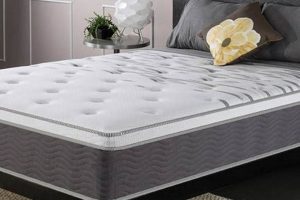
The effective preservation of a sleeping surface, specifically a mattress, involves a series of steps designed to protect its integrity and prolong its lifespan during periods of disuse. These steps typically include thorough cleaning, proper wrapping, and appropriate environmental control during the inactive storage period. The goal is to prevent damage from dust, moisture, pests, and physical deformation.
The judicious care and maintenance of a mattress during storage can yield significant benefits. It mitigates the risk of mold and mildew growth, prevents infestations, and maintains the mattress’s original comfort and support. Historically, methods for preserving mattresses have evolved from simple coverings to sophisticated vacuum-sealing techniques, reflecting advancements in material science and storage solutions.
The following sections will detail the specific procedures involved in preparing a mattress for storage, selecting suitable storage locations, and implementing long-term maintenance strategies to ensure the mattress remains in optimal condition until it is needed again. The discussion will cover essential considerations for different types of mattresses and storage environments.
Mattress Preservation Guidelines
The following guidelines offer a structured approach to maximizing the lifespan and condition of a mattress during storage.
Tip 1: Thorough Cleaning is Essential: Before initiating storage, the mattress must undergo a complete cleaning. Vacuum all surfaces to remove dust mites, debris, and potential allergens. Spot-clean any stains using a mild detergent and water solution, ensuring the mattress is completely dry before proceeding.
Tip 2: Invest in Protective Covering: Enclose the mattress within a breathable, waterproof mattress bag. This barrier shields it from moisture, pests, and dust accumulation during the storage period. Secure the bag tightly to prevent any ingress.
Tip 3: Controlled Storage Environment: Select a storage location characterized by minimal temperature fluctuations and low humidity. Avoid areas prone to leaks, flooding, or direct sunlight exposure. Ideal storage spaces include climate-controlled storage units or dry, well-ventilated rooms.
Tip 4: Flat Orientation is Preferable: Storing the mattress flat, rather than on its side, distributes weight evenly and minimizes the risk of structural deformation. If vertical storage is unavoidable due to space constraints, rotate the mattress regularly to prevent sagging.
Tip 5: Elevate the Mattress: Place the mattress on a pallet or elevated platform to promote air circulation and prevent moisture absorption from the floor. This measure is especially crucial in basements or other areas with potential dampness.
Tip 6: Monitor Periodically: During extended storage periods, conduct regular inspections of the mattress for any signs of mold, mildew, or pest activity. Address any issues promptly to mitigate potential damage.
Tip 7: Avoid Stacking: Refrain from placing heavy objects on top of the mattress. This can lead to compression and permanent indentations, compromising its structural integrity and comfort.
Adhering to these preservation strategies safeguards the mattress against potential damage, ensuring its readiness for future use. The long-term benefits of these practices include extended mattress lifespan and a maintained level of comfort and support.
The concluding section will offer insights into the safe and effective retrieval of the mattress from storage, preparing it for immediate use.
1. Cleanliness

Maintaining a sanitary state is paramount to the effective preservation of a mattress during storage. The presence of organic matter, dust, and moisture creates a conducive environment for microbial growth and pest infestation, significantly compromising the mattress’s integrity and future usability. Therefore, thorough sanitation practices are an indispensable component of mattress preservation.
- Mitigating Mold and Mildew Growth
Residual moisture and organic debris within a mattress provide an ideal substrate for mold and mildew proliferation. These microorganisms can degrade the mattress’s internal structure, produce unpleasant odors, and pose potential health risks to future users. Eliminating sources of moisture and nutrients through meticulous cleaning significantly reduces the likelihood of microbial growth during storage.
- Controlling Dust Mite Infestations
Mattresses are a natural habitat for dust mites, microscopic arthropods that thrive on shed skin cells. Dust mite populations can explode during storage, leading to increased allergen concentrations and potential allergic reactions upon subsequent use. Thorough vacuuming and cleaning before storage minimize the existing dust mite population and deprive them of a food source, thereby controlling infestation.
- Preventing Pest Attraction
Organic matter and food particles embedded within a mattress can attract insects and rodents, leading to structural damage and unsanitary conditions. A clean mattress offers minimal appeal to pests, reducing the risk of infestation and the associated damage. Regular cleaning regimens thus act as a preventative measure against pest-related deterioration during storage.
- Enhancing Long-Term Hygiene
Beyond preventing specific problems, cleanliness contributes to the overall hygiene of the mattress. Removing accumulated dirt, debris, and odors ensures that the mattress remains fresh and sanitary for future use. This proactive approach extends the mattress’s lifespan and maintains its comfort and quality over extended periods of disuse.
In summary, sanitation plays a vital role in effective preservation. From reducing the potential for mold and mildew growth to managing dust mite populations and preventing pest infestations, cleanliness ensures that the mattress remains in optimal condition throughout its storage period, ready to provide a clean and comfortable sleeping surface upon its eventual return to service.
2. Protective Covering

A protective covering is an indispensable component of effective mattress storage. Its primary function is to shield the mattress from environmental contaminants and physical damage during periods of inactivity. The absence of such a covering exposes the mattress to a range of detrimental elements, significantly reducing its lifespan and compromising its hygiene.
Consider a scenario where a mattress is stored in a garage without a protective covering. Dust, dirt, and potential moisture permeate the fabric, creating an environment conducive to mold growth and pest infestation. Over time, the mattress may develop unsightly stains, unpleasant odors, and structural damage. In c
ontrast, a mattress encased in a waterproof, breathable cover remains protected from these elements, preserving its cleanliness, integrity, and overall usability. The financial implications are significant. A damaged mattress requires replacement, while a properly protected mattress represents a preserved asset.
The selection of an appropriate protective covering is critical. Materials should be breathable to prevent moisture buildup and waterproof to guard against spills and leaks. Reinforced seams and durable construction ensure resistance to tears and punctures during handling and storage. In summary, a protective covering functions as a barrier against environmental hazards, contributing directly to the long-term preservation of the mattress and, as a result, representing a fundamental step in effective mattress storage. Without it, all other preservation efforts are rendered less effective.
3. Environment Control
Effective mattress preservation during storage is inextricably linked to environmental control. The ambient conditions of the storage location exert a significant influence on the mattress’s long-term condition, impacting its structural integrity, hygiene, and overall usability. Managing these environmental factors is therefore a crucial aspect of proper mattress storage.
- Temperature Regulation
Extreme temperature fluctuations can degrade mattress materials. Excessive heat can lead to foam breakdown and adhesive failure, while freezing temperatures can cause fibers to become brittle and crack. Maintaining a stable temperature within a moderate range prevents these types of damage. For example, a climate-controlled storage unit, held at a consistent temperature between 50F and 80F, provides a suitable environment for long-term mattress storage. Conversely, an uninsulated attic, subject to seasonal temperature extremes, poses a significant risk to the mattress’s condition.
- Humidity Management
Elevated humidity levels promote the growth of mold, mildew, and bacteria within the mattress. These microorganisms can cause staining, unpleasant odors, and structural decay. Conversely, excessively dry conditions can lead to material desiccation and cracking. Maintaining a relative humidity level below 50% is critical for preventing microbial growth and preserving the mattress’s integrity. Dehumidifiers or desiccants can be employed to control humidity in storage locations with poor ventilation. Storing a mattress in a damp basement without humidity control measures would likely result in mold and mildew infestation.
- Light Exposure Mitigation
Prolonged exposure to direct sunlight can fade fabrics and degrade foam and other mattress materials. Ultraviolet radiation breaks down chemical bonds within the mattress, leading to discoloration, brittleness, and reduced structural integrity. Storing the mattress in a dark or dimly lit location minimizes the damaging effects of sunlight. Covering the mattress with a light-blocking material further enhances protection. Leaving a mattress exposed to direct sunlight through a window for extended periods would accelerate its degradation.
- Ventilation Provision
Adequate ventilation is essential for preventing moisture accumulation and promoting air circulation around the mattress. Stagnant air can trap moisture, creating a breeding ground for mold and mildew. Proper ventilation allows moisture to evaporate and prevents the buildup of unpleasant odors. Ensuring sufficient airflow within the storage location helps to maintain a dry and hygienic environment for the mattress. Storing a mattress tightly sealed in a plastic bag without ventilation would likely lead to moisture buildup and subsequent microbial growth.
In summary, environmental control is a multifaceted aspect of proper mattress storage. By carefully managing temperature, humidity, light exposure, and ventilation, one can effectively mitigate the risks of damage and degradation, ensuring that the mattress remains in optimal condition until it is needed again. Neglecting these environmental factors can significantly reduce the mattress’s lifespan and compromise its hygiene, leading to costly replacements or health concerns.
4. Orientation

The physical positioning, or orientation, of a mattress during storage is a critical determinant of its long-term structural integrity and comfort. Improper orientation can lead to irreversible deformation, uneven wear, and a diminished lifespan. Therefore, careful consideration of the mattress’s orientation is essential for effective preservation.
- Horizontal Storage: Optimal Weight Distribution
Storing a mattress horizontally, in a flat position, provides the most uniform distribution of weight across its surface. This prevents localized stress points that can cause sagging or indentations. For instance, a memory foam mattress stored horizontally on a flat surface will maintain its shape and support characteristics more effectively than one stored vertically. Horizontal storage minimizes the risk of long-term compression damage.
- Vertical Storage: Space Efficiency and Potential Risks
Vertical storage, where the mattress is placed on its side, is often employed to conserve space. However, this method introduces the risk of uneven weight distribution, potentially leading to the mattress bowing or sagging over time. The continuous pressure on the lower edge can compress the internal materials. If vertical storage is unavoidable, rotating the mattress periodically can help mitigate these risks, distributing the stress more evenly.
- Foundation Compatibility: Maintaining Support Structure
The presence or absence of a foundation during storage can influence the required orientation. If storing a mattress without its corresponding foundation, ensuring a flat, stable surface is even more critical. An uneven storage surface can exacerbate the risks associated with both horizontal and vertical storage, leading to distortion and reduced comfort. Using a pallet or platform to elevate the mattress can provide a more stable and supportive base.
- Regular Rotation: Mitigating Long-Term Effects
Regardless of the chosen orientation, periodic rotation of the mattress can help to distribute weight and minimize the effects of prolonged pressure on specific areas. This practice is particularly important for innerspring mattresses, where the coils can settle over time. Rotating the mattress 180 degrees every few months, even during storage, can contribute to more even wear and extend its lifespan.
The choice of orientation significantly impacts the longevity and quality of a stored mattress. While horizontal storage is generally preferred due to its uniform weight distribution, space constraints may necessitate vertical storage. In such cases, employing preventative measures such as rotation and ensuring a stable foundation are crucial for mitigating potential damage. Careful attention to orientation is therefore a key element of effective mattress preservation during storage.
5. Elevation

Elevation, in the context of ma
ttress storage, refers to the practice of raising the mattress off the ground. This seemingly simple measure is a critical factor influencing the preservation and longevity of the mattress during periods of inactivity. Maintaining separation between the mattress and the floor provides several significant benefits, acting as a safeguard against potential damage and degradation.
- Moisture Mitigation
Direct contact with the floor exposes the mattress to potential moisture absorption, particularly in environments with high humidity or poor ventilation. Concrete floors, for instance, can wick moisture from the surrounding environment, which can then be transferred to the mattress. This moisture can lead to the growth of mold, mildew, and bacteria within the mattress, causing unpleasant odors, structural damage, and potential health risks. Elevation, through the use of pallets, platforms, or risers, creates an air gap that allows for ventilation, reducing the risk of moisture accumulation and subsequent microbial growth.
- Pest Deterrence
Floors often harbor insects and rodents that can infest a stored mattress. Direct contact with the floor provides easy access for these pests to burrow into the mattress, causing structural damage and unsanitary conditions. Elevation creates a physical barrier that makes it more difficult for pests to reach the mattress, deterring infestations and minimizing the risk of damage. For example, raising the mattress a few inches off the floor can significantly reduce the likelihood of rodent or insect entry.
- Improved Air Circulation
Elevation promotes air circulation around the mattress, preventing the build-up of stagnant air and moisture. Proper air circulation helps to maintain a dry and hygienic environment, inhibiting the growth of mold and mildew and reducing the risk of unpleasant odors. This is particularly important in storage locations with limited ventilation. A mattress placed directly on the floor, in contrast, restricts airflow and creates a breeding ground for microbial growth.
- Damage Prevention
Dragging a mattress across the floor can cause tears, abrasions, and other physical damage to the fabric and internal components. Elevation eliminates the need to drag the mattress, preventing this type of damage and preserving its aesthetic appeal and structural integrity. Furthermore, elevation can protect the mattress from spills or leaks that may occur on the floor, preventing staining and water damage.
In summary, elevation is a critical element of proper mattress storage, playing a vital role in moisture mitigation, pest deterrence, improved air circulation, and damage prevention. By raising the mattress off the floor, one can significantly reduce the risks of degradation and damage, ensuring that the mattress remains in optimal condition for future use. Neglecting this simple yet effective measure can compromise the mattress’s hygiene, structural integrity, and overall lifespan.
Frequently Asked Questions
This section addresses common inquiries regarding the optimal methods for preserving a mattress during periods of storage. The information provided is intended to offer practical guidance and dispel potential misconceptions.
Question 1: What is the most suitable location for storing a mattress?
The ideal storage location is characterized by a stable temperature, low humidity, and protection from direct sunlight. Climate-controlled storage units or dry, well-ventilated rooms within a dwelling are generally preferable.
Question 2: Is it necessary to clean a mattress before storage?
Thorough cleaning prior to storage is essential. Vacuuming removes dust mites and debris, while spot cleaning addresses stains. Ensuring the mattress is completely dry is crucial to prevent mold growth.
Question 3: What type of covering is recommended for mattress storage?
A breathable, waterproof mattress bag is recommended. This protects against moisture, pests, and dust while allowing for air circulation, preventing mildew formation.
Question 4: Should a mattress be stored flat or on its side?
Horizontal storage is generally preferred as it distributes weight evenly, minimizing the risk of deformation. If vertical storage is unavoidable, rotating the mattress periodically is advised.
Question 5: Is it important to elevate a mattress during storage?
Elevating the mattress on a pallet or platform promotes air circulation and prevents moisture absorption from the floor, particularly in damp environments.
Question 6: How often should a stored mattress be inspected?
Regular inspections are recommended, particularly during extended storage. Look for signs of mold, mildew, or pest activity and address any issues promptly.
Proper mattress storage involves a combination of cleaning, protection, and environmental control. Adhering to these practices will help preserve the mattress’s integrity and extend its lifespan.
The subsequent section will offer insights into inspecting a mattress upon removal from storage and ensuring its readiness for use.
The Imperative of Proper Mattress Preservation
The preceding sections have explored the critical elements involved in “how do you store a mattress” effectively. From meticulous cleaning and robust protective coverings to stringent environmental controls, appropriate orientation, and strategic elevation, each step contributes to safeguarding the integrity of the mattress. The absence of any of these precautions significantly elevates the risk of damage, contamination, and premature degradation.
Therefore, diligent adherence to these guidelines is not merely recommended but essential for anyone seeking to preserve the investment in their mattress. Failure to implement these practices can result in substantial financial losses, health risks, and the compromised comfort of future use. Mattress preservation demands a proactive and informed approach, ultimately ensuring a sound and healthy sleeping surface for years to come. Prioritize these steps; the long-term benefits are undeniable.