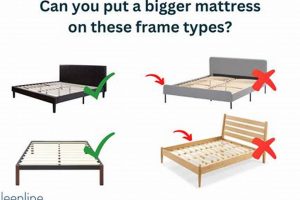
The question of whether a smaller mattress is compatible with a larger bed frame is frequently encountered. Specifically, individuals often inquire about the feasibility of placing a full-size mattress on a queen-size bed frame. A full mattress, measuring approximately 54 inches wide and 75 inches long, is designed for smaller spaces and single sleepers. A queen mattress, in contrast, measures roughly 60 inches wide and 80 inches long, offering more space for couples or individuals who prefer extra room.
Addressing this dimensional discrepancy is crucial for several reasons. Attempting to utilize a smaller mattress on a larger frame can lead to instability and inadequate support, potentially impacting sleep quality and mattress longevity. Understanding these size differences also benefits consumers making purchasing decisions, ensuring proper fit and optimal use of their sleep investment. Historically, standardized mattress sizes have evolved to meet varying needs and room dimensions, making informed choices essential.
Therefore, a thorough examination of the potential consequences and practical solutions surrounding the use of a full mattress with a queen bed frame is warranted. This includes considering alternatives, modifications, and the overall impact on comfort and support. Further discussion will detail the potential issues and provide guidance for achieving a suitable sleep environment.
Considerations for Full Mattress and Queen Bed Frame Compatibility
The utilization of a full mattress on a queen bed frame presents potential challenges. Prior consideration of these factors is crucial for ensuring both comfort and structural integrity.
Tip 1: Assess the Gap: When a full mattress is placed on a queen frame, a noticeable gap will exist. This gap can compromise support and lead to discomfort.
Tip 2: Implement Fillers: Employing fillers, such as rolled blankets or custom-cut foam, can partially fill the space. Ensure the fillers are consistently sized and securely positioned to prevent shifting.
Tip 3: Evaluate Frame Structure: Some queen bed frames have slats spaced too far apart for adequate support of a full mattress. Reinforcements may be necessary to prevent mattress sagging.
Tip 4: Mind the Aesthetics: The visible gap can detract from the overall appearance of the bed. Consider a bed skirt or other decorative elements to conceal the space.
Tip 5: Monitor Stability: Regularly check the mattress and frame for any signs of instability or movement. Address any issues promptly to avoid further problems.
Tip 6: Consider Long-Term Implications: While temporary solutions may suffice, the use of a smaller mattress on a larger frame is not a long-term substitute for a properly sized mattress.
Addressing the challenges associated with using a smaller mattress on a larger frame requires careful attention to detail and a commitment to ensuring proper support and stability. While temporary solutions are possible, the optimal solution involves using a mattress that is appropriately sized for the bed frame.
The following section will offer alternative solutions for addressing the mismatch between mattress and frame sizes, ensuring a more comfortable and supportive sleep environment.
1. Size Discrepancy

The core issue when considering the placement of a full mattress on a queen bed frame stems from a fundamental size discrepancy. A full mattress, typically measuring 54 inches wide and 75 inches long, is significantly smaller than a queen mattress, which is approximately 60 inches wide and 80 inches long. This difference in dimensions creates a void when a full mattress occupies a queen frame, resulting in uneven weight distribution and compromised support. For example, a person sleeping near the edge of the full mattress on a queen frame may experience a lack of support due to the empty space surrounding the mattress. This instability can negatively affect sleep quality and potentially lead to discomfort or even back pain.
The importance of recognizing this size discrepancy is paramount in making informed decisions about sleep arrangements. Without addressing this issue, the functionality and comfort of the bed are significantly reduced. While makeshift solutions such as filling the gap with pillows or rolled blankets might seem viable, these measures are often inadequate for providing consistent support and can create an uneven sleeping surface. The physical space difference not only impacts comfort but also the structural integrity of the bed setup. The bed frame is designed to support a specific size and weight distribution; deviating from this design can cause long-term damage to both the frame and the mattress.
In summary, the dimensional divergence between a full mattress and a queen bed frame directly impacts the suitability of using the former on the latter. The resulting lack of support and potential for structural instability highlight the critical need for addressing this size discrepancy. While temporary fixes are possible, the optimal solution involves utilizing a mattress that corresponds directly to the frame’s intended dimensions, ensuring both comfort and the longevity of the sleep setup.
2. Frame Dimensions
Frame dimensions are a critical determinant in evaluating the compatibility of a full mattress with a queen bed frame. The standard queen bed frame is designed to accommodate a mattress measuring approximately 60 inches in width and 80 inches in length. Conversely, a full-size mattress measures roughly 54 inches wide and 75 inches long. This dimensional difference results in a substantial gap, approximately 3 inches on each side and 2.5 inches at the foot of the bed, when a full mattress is placed within a queen frame. This gap compromises the intended support system of the frame, as the mattress does not fully engage with the structural elements designed to distribute weight and maintain stability. Consider, for example, a slatted bed frame where the slats are spaced to adequately support a queen mattress. The narrower full mattress will leave a portion of the slats unsupported, potentially leading to uneven weight distribution and mattress sagging.
The implications of mismatched frame dimensions extend beyond mere aesthetics. The absence of proper support can accelerate wear and tear on the mattress itself, reducing its lifespan and potentially voiding warranty claims. Moreover, the resulting instability can disrupt sleep patterns, as the mattress may shift or rock within the frame, particularly when weight is applied unevenly. Filling the gap with makeshift solutions like rolled towels or foam inserts may provide a temporary remedy, but these solutions often lack the consistent density and structural integrity required for long-term support. Furthermore, many queen bed frames, especially platform styles, lack a recessed edge to secure the mattress. Without this feature, a full mattress is more prone to sliding around, further exacerbating the instability. Therefore, the dimensional specifications of the frame directly dictate the feasibility and suitability of using a full mattress on a queen bed frame.
In conclusion, the connection between frame dimensions and mattress compatibility is undeniable. The significant size disparity between a full mattress and a queen bed frame leads to compromised support, potential mattress damage, and disrupted sleep. While temporary measures may mitigate some of these issues, they do not address the fundamental problem of dimensional incompatibility. The ideal solution remains the use of a mattress that precisely matches the frame’s dimensions, ensuring optimal support, stability, and longevity of both the mattress and the frame. Understanding these dimensional constraints is paramount for consumers seeking to create a comfortable and functional sleep environment.
3. Support Structure

The support structure is a crucial element when evaluating the use of a full mattress on a queen bed frame. A bed frame’s support system is designed to distribute weight evenly across the mattress, ensuring proper spinal alignment and minimizing wear. However, dimensional discrepancies between a full mattress and a queen frame can significantly compromise this system.
- Slatted Support
Slatted bed frames rely on evenly spaced slats to provide a uniform foundation for the mattress. When a full mattress is placed on a queen frame with slats, gaps emerge between the mattress edges and the slats. This results in uneven weight distribution, potentially causing the mattress to sag in unsupported areas. For instance, an individual sleeping near the edge of the full mattress might experience a lack of support, leading to discomfort and potential back pain. The effectiveness of slatted support is contingent upon the mattress occupying the full dimensions of the frame.
- Platform Support
Platform beds typically feature a solid or closely spaced support surface. While a solid platform offers more uniform support than slats, the dimensional difference remains problematic. The full mattress will not extend to the edges of the queen frame, creating unused space. This can lead to instability, especially if the mattress is not secured. Consider a scenario where someone sits on the edge of the bed; the unsupported area may cause the mattress to tilt or shift. A platform bed’s inherent design for a specific mattress size is disrupted when a smaller mattress is used.
- Box Spring Foundation
A box spring provides additional support and elevation for the mattress. However, using a full mattress on a queen box spring exacerbates the dimensional mismatch. The box spring will extend beyond the edges of the mattress, creating an unstable and aesthetically unappealing arrangement. This can lead to increased wear on the box spring and a compromised sleep surface. The primary function of a box spring, to evenly distribute weight and absorb shock, is undermined when the mattress does not fully occupy its surface.
- Center Support Beam
Many queen bed frames include a center support beam to prevent sagging, particularly important for larger mattresses and heavier individuals. However, if a full mattress is used, the weight distribution may not properly engage this center support. This can lead to uneven pressure on the mattress and frame, potentially accelerating wear and reducing the overall lifespan of the bed. The center support’s effectiveness is predicated on the mattress fully utilizing the frame’s dimensions; a smaller mattress negates its intended purpose.
The integrity of the support structure is fundamentally linked to the dimensions of the mattress and frame. Placing a full mattress on a queen bed frame inevitably compromises the intended support system, resulting in uneven weight distribution, potential mattress damage, and reduced sleep quality. While temporary solutions like gap fillers may offer slight improvement, they cannot replicate the consistent support provided by a properly sized mattress. Understanding these limitations is crucial for making informed decisions about sleep arrangements.
4. Gap Filling

Gap filling emerges as a prominent consideration when evaluating the feasibility of using a full mattress on a queen bed frame. The size disparity between the mattress and frame necessitates strategies to address the resulting empty space, influencing both comfort and support.
- Compromised Support and Alignment
The primary function of gap filling is to compensate for the reduced contact between the mattress and the bed frame’s support structure. Without gap filling, the mattress may sag or shift, leading to uneven weight distribution and compromised spinal alignment. For example, individuals sleeping near the edge of the mattress might experience a lack of support, potentially causing discomfort or back pain. Proper gap filling aims to mitigate these issues by providing additional support in the void spaces.
- Material Choices and Effectiveness
Various materials can be employed for gap filling, each with varying degrees of effectiveness. Rolled towels, pillows, and foam inserts are commonly used. However, these solutions often lack the density and uniformity required for consistent support. Custom-cut foam pieces, tailored to the specific dimensions of the gap, offer a more precise and reliable solution. The choice of material directly impacts the effectiveness of gap filling in maintaining a stable and supportive sleep surface.
- Aesthetic Considerations
Beyond functionality, gap filling influences the overall aesthetics of the bed. Visible gaps between the mattress and frame can detract from the bed’s appearance. Utilizing gap-filling materials that blend seamlessly with the existing bedding can enhance the bed’s visual appeal. For instance, a bed skirt can conceal gaps while also providing a cohesive design element. Aesthetic considerations play a role in determining the acceptability of gap filling as a solution.
- Long-Term Viability
While gap filling can provide a temporary solution, it is not a substitute for a properly sized mattress. Over time, gap-filling materials may compress or shift, requiring frequent adjustments. Furthermore, the underlying issue of mismatched dimensions remains, potentially leading to accelerated wear and tear on both the mattress and frame. Long-term viability hinges on the suitability of gap filling as a sustainable solution compared to acquiring a queen-sized mattress.
Gap filling represents a practical, albeit imperfect, approach to address the challenges presented by using a full mattress on a queen bed frame. While it can mitigate issues related to support, stability, and aesthetics, it is crucial to recognize its limitations and consider the long-term implications. Ultimately, the decision to employ gap filling should be weighed against the benefits of investing in a mattress that corresponds directly to the frame’s dimensions.
5. Sleep Quality

Sleep quality, an essential determinant of overall well-being, is significantly influenced by the congruence between mattress size and bed frame dimensions. The practice of using a full mattress on a queen bed frame introduces factors that can negatively impact restorative sleep.
- Support and Spinal Alignment
A properly sized mattress provides uniform support, maintaining spinal alignment throughout the night. When a full mattress is placed on a queen frame, gaps arise, leading to uneven support. This can cause the spine to misalign, resulting in discomfort, restless sleep, and potential musculoskeletal issues. For example, an individual may unconsciously adjust their sleeping position to compensate for the lack of support, disrupting sleep cycles.
- Stability and Movement
A stable sleep surface is crucial for uninterrupted sleep. The dimensional mismatch between a full mattress and a queen frame can create instability, causing the mattress to shift or rock during movement. This instability can trigger awakenings or lighter sleep stages, reducing the overall depth and quality of sleep. Consider the instance of a sleeper turning over; the movement may be amplified by the unstable mattress, leading to a disruptive wake-up.
- Temperature Regulation
Optimal sleep quality is often associated with consistent temperature regulation. The gaps created by using a full mattress on a queen frame can disrupt airflow and temperature control. These gaps may allow for increased heat dissipation in colder environments or reduced ventilation in warmer settings, affecting the sleeper’s comfort and potentially impacting sleep cycles. For example, the increased air circulation can make the sleeper feel colder than usual, disrupting their sleep.
- Psychological Impact
The psychological aspect of sleep environment significantly affects restfulness. A visibly mismatched mattress and frame can induce a sense of unease or dissatisfaction, subconsciously impacting sleep quality. The knowledge of an inadequate sleep setup can create a mental distraction, hindering relaxation and the ability to fall asleep easily. The sleeper might find it difficult to fully relax knowing their sleep environment is not optimal.
These facets collectively illustrate the negative impact of using a full mattress on a queen bed frame on sleep quality. While solutions such as gap fillers may offer marginal improvements, they do not address the fundamental issue of dimensional incompatibility. Achieving optimal sleep quality necessitates a mattress that precisely matches the frame’s dimensions, ensuring adequate support, stability, temperature regulation, and a conducive psychological environment.
6. Aesthetic Impact

The aesthetic impact of using a full mattress on a queen bed frame is a significant, yet often overlooked, consideration. The visual disconnect created by the size disparity can detract from the overall appearance of a bedroom. A queen bed frame, designed to fully encase a larger mattress, exhibits an incomplete and potentially unappealing appearance when fitted with a smaller full mattress. This can manifest as visible gaps around the perimeter of the mattress, disrupting the intended clean lines and balanced proportions of the bed. For example, a meticulously decorated room featuring a queen bed can appear visually compromised if the mattress is noticeably smaller than the frame, creating an impression of incompleteness or a lack of attention to detail. The aesthetic impact is not merely superficial; it contributes to the overall sense of harmony and comfort within the sleep environment.
Addressing this aesthetic issue is crucial for those who prioritize a visually appealing bedroom. Solutions range from concealing the gaps with strategically placed pillows or bed skirts to more involved modifications of the bed frame itself. However, these solutions often present practical challenges. Pillows can shift during sleep, negating their visual effect, while bed skirts may not fully conceal the gaps depending on the frame’s design. Modifications to the frame may require specialized skills and resources. Therefore, the aesthetic impact represents a tangible drawback to using a full mattress on a queen bed frame, necessitating careful consideration of potential remedies and their limitations. The choice often boils down to balancing functionality and visual appeal, weighing the cost and effort of aesthetic corrections against the convenience of using the smaller mattress.
In conclusion, the aesthetic impact constitutes a relevant aspect of the compatibility question. The visual discordance created by the size mismatch directly influences the perceived quality of the sleep environment. While mitigation strategies exist, they frequently involve compromises or additional effort. Consequently, recognizing and addressing the aesthetic implications is essential for individuals seeking to optimize both the comfort and visual harmony of their bedroom space. Ultimately, prioritizing a mattress that corresponds precisely to the bed frame’s dimensions offers the most effective approach to achieving a cohesive and aesthetically pleasing outcome.
7. Long-term Viability

The long-term viability of utilizing a full mattress on a queen bed frame represents a critical consideration, extending beyond immediate cost savings or temporary convenience. The decision carries implications for support, comfort, and the lifespan of both the mattress and frame. Assessing the practicality of this arrangement necessitates a comprehensive understanding of the associated drawbacks.
- Mattress Longevity
Placing a smaller mattress on a larger frame can accelerate wear. The uneven weight distribution subjects specific areas of the mattress to increased stress, potentially leading to premature sagging or deformation. For example, the edges of the mattress, unsupported by the queen frame, may break down faster than the center. This diminished lifespan negates any initial cost savings and may necessitate earlier replacement.
- Frame Integrity
A queen bed frame is engineered to support a mattress of specific dimensions and weight. Using a smaller full mattress can compromise the structural integrity of the frame over time. The reduced surface contact and altered weight distribution may place undue stress on certain frame components, leading to warping, cracking, or joint failure. This can result in costly repairs or the need for a complete frame replacement, offsetting the initial convenience of using the existing frame.
- Ongoing Costs and Maintenance
The necessity for supplementary materials, such as gap fillers, represents an ongoing expense. These materials, including foam inserts or rolled blankets, require periodic replacement due to compression or shifting. Furthermore, the instability created by the mismatched sizes may necessitate frequent adjustments or realignments to maintain a semblance of comfort. These recurring costs and maintenance efforts detract from the long-term viability of this arrangement.
- Evolving Sleep Needs
Individual sleep needs change over time, influenced by factors such as age, weight, and health conditions. An arrangement that is initially acceptable may become inadequate as these needs evolve. A full mattress on a queen frame may prove insufficient to provide adequate support or comfort, leading to compromised sleep quality and potential health consequences. The long-term viability of this setup hinges on its ability to adapt to changing sleep requirements.
In summation, the long-term viability of placing a full mattress on a queen bed frame is questionable. The potential for accelerated mattress and frame wear, recurring expenses associated with gap fillers, and the inflexibility to accommodate evolving sleep needs collectively undermine the practicality of this arrangement. While short-term expediency may be appealing, a comprehensive assessment reveals that a properly matched mattress and frame represent a more sustainable and cost-effective investment in the long run. Prioritizing a suitable match ensures optimal support, comfort, and durability, contributing to improved sleep quality and overall well-being.
Frequently Asked Questions
The following questions address common concerns and misconceptions regarding the use of a full-size mattress on a queen-size bed frame. The responses provide factual information to guide informed decision-making.
Question 1: Is it physically possible to place a full mattress on a queen bed frame?
Yes, a full mattress can physically rest on a queen bed frame. However, a significant size discrepancy will exist, resulting in gaps around the mattress perimeter.
Question 2: Will a full mattress adequately support an individual if placed on a queen bed frame?
Adequate support is compromised due to the size difference. The full mattress will not fully engage the frame’s support structure, potentially leading to uneven weight distribution and discomfort.
Question 3: Are there any risks to the mattress or frame if a full mattress is used on a queen frame?
Yes, risks exist. The full mattress may experience accelerated wear and sagging due to the lack of complete support. The queen frame may also be subjected to uneven stress, potentially leading to structural damage over time.
Question 4: What are some temporary solutions to address the gap between a full mattress and a queen bed frame?
Temporary solutions include using rolled towels, pillows, or custom-cut foam to fill the gaps. However, these solutions provide inconsistent support and require frequent adjustment.
Question 5: Does using a smaller mattress on a larger frame affect the bed’s appearance?
Yes, the visual gaps created by using a full mattress on a queen frame can detract from the bed’s overall aesthetic appeal. The result is often an unfinished or mismatched look.
Question 6: Is it more cost-effective in the long run to use a full mattress on a queen bed frame?
No, it is generally not more cost-effective long-term. The accelerated wear on both the mattress and frame, coupled with the need for replacement gap fillers, can outweigh the initial savings. Purchasing the correct mattress size is often the more sustainable solution.
These FAQs aim to provide clarity on the practical considerations surrounding the use of a smaller mattress on a larger frame. While temporary solutions exist, the optimal outcome involves ensuring compatibility between mattress size and frame dimensions.
The subsequent section will explore alternative solutions that ensure a comfortable and supportive sleep environment.
Can a Full Mattress Fit on a Queen Bed Frame
This exploration has detailed the multifaceted implications of attempting to accommodate a full mattress on a queen bed frame. Size discrepancies inevitably compromise support, potentially leading to accelerated wear on both the mattress and frame. Makeshift solutions, while offering temporary mitigation, lack the consistency and stability required for sustained comfort and structural integrity. The aesthetic impact further detracts from the overall sleep environment, potentially impacting psychological well-being. Ultimately, the inquiry reveals a fundamental incompatibility that extends beyond mere physical dimensions.
Therefore, prioritizing a properly sized mattress remains the most prudent course of action. While the allure of utilizing existing resources may prove tempting, a comprehensive understanding of the long-term drawbacks underscores the importance of investing in a compatible sleep setup. The decision directly influences not only immediate comfort but also the longevity of the sleep environment and the overall quality of rest. Consequently, informed consumers should recognize the inherent limitations and opt for solutions that promote optimal support, stability, and long-term value.
![Ultimate King Size Bed Frame with Mattress [Deals] | Organic & Natural Mattress Buyer’s Guide: Non-Toxic Sleep Solutions](https://mattressworldpa.com/wp-content/uploads/2025/07/th-3215-300x200.jpg "Ultimate King Size Bed Frame with Mattress [Deals] Organic & Natural Mattress Buyer’s Guide: Non-Toxic Sleep Solutions")
![Best Queen Frame with Air Mattress [Deals!] | Organic & Natural Mattress Buyer’s Guide: Non-Toxic Sleep Solutions](https://mattressworldpa.com/wp-content/uploads/2025/07/th-3213-300x200.jpg "Best Queen Frame with Air Mattress [Deals!] Organic & Natural Mattress Buyer’s Guide: Non-Toxic Sleep Solutions")